
The Unseen Threat to Your Long Island Business
What is business interruption insurance? It's coverage that replaces lost income and pays for ongoing expenses when a covered disaster forces your business to close temporarily. Also known as business income insurance, it helps you stay financially afloat even when your doors are physically shut.
Quick Facts:
- Covers: Lost profits, employee wages, rent, taxes, and loan payments.
- Triggers: Physical damage from covered events like fire, theft, or storms.
- Standard Period: 30 days, but this is often too short for a Long Island business.
- Not a Standalone Policy: Usually added to your property insurance.
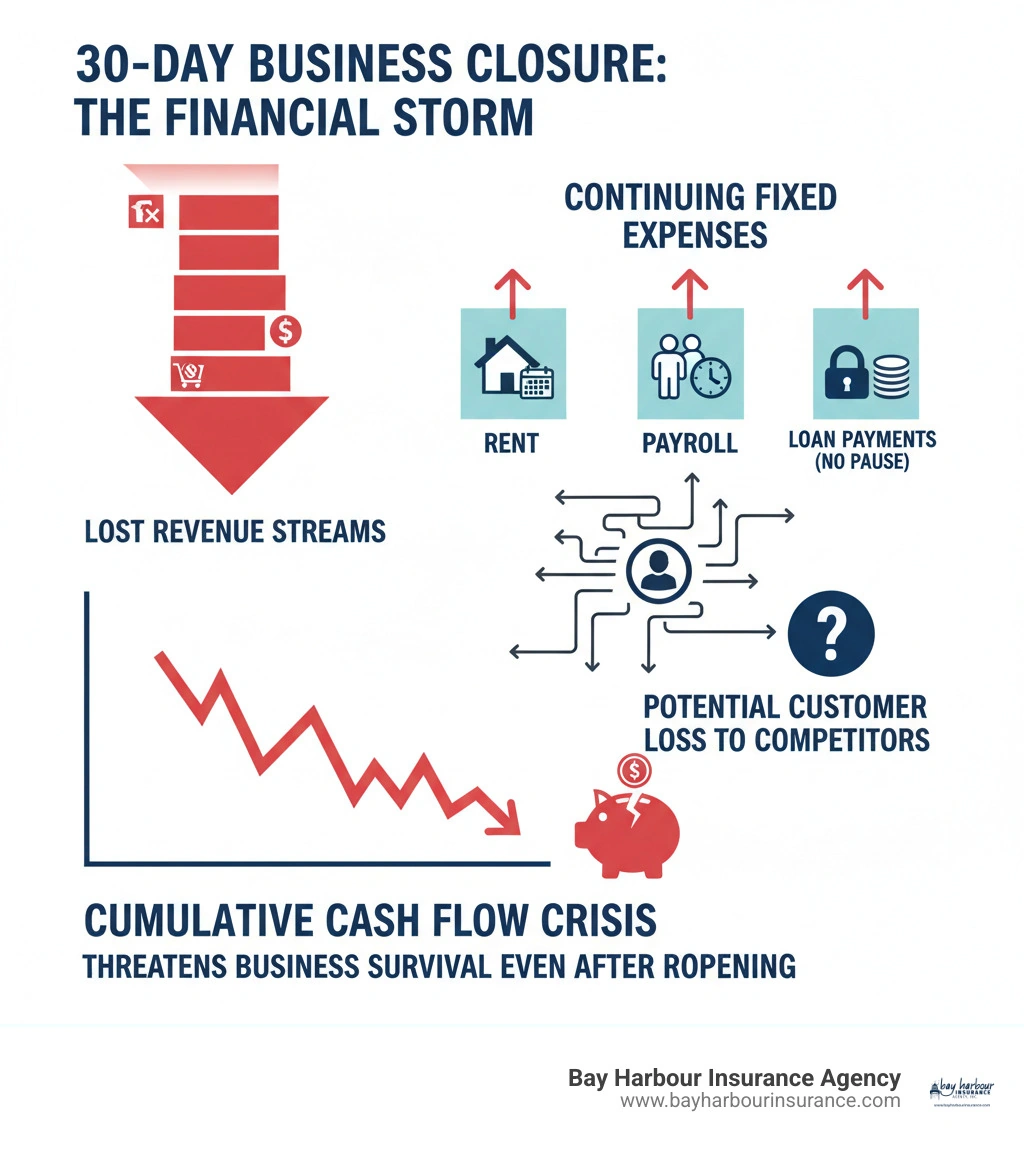
Business owners in Patchogue, Holbrook, and Medford know to insure their buildings. But what happens when a nor'easter knocks out power for a week, or a fire in Holtsville forces a two-month closure? Your mortgage, payroll, and loan payments don't stop. The numbers are sobering: 40% of businesses that close after a disaster never reopen.
For businesses across Long Island, from the shops in Patchogue to manufacturers in Holtsville, the risks are diverse. Storms, power grid failures, and supply chain issues can halt operations in Holbrook and Medford without warning. Business interruption insurance addresses this invisible threat, which ranks among the top risks for companies globally, according to a 2024 global risk survey. For any Long Island business, it's essential for survival.
What is Business Interruption Insurance and Why Does It Matter?
What is business interruption insurance? It's a financial safety net that keeps your business alive when disaster strikes. Also called business income insurance, it replaces the money you would have earned and helps pay ongoing bills when you're forced to close due to physical damage from a covered event.
Imagine a kitchen fire forces your successful Patchogue restaurant to shut down for two months. Your property insurance covers fixing the kitchen, but what about the lost revenue, employee paychecks, and rent? That's where business interruption insurance becomes a lifeline, bridging the gap between physical damage and financial survival for businesses in Holbrook, Holtsville, and across Long Island.
This coverage is critical for every business on Long Island. A 2024 global risk barometer ranks business interruption as a top global threat. For small businesses in Patchogue, Holbrook, or Medford, it can mean the difference between reopening and closing for good. We're not just protecting buildings; we're protecting livelihoods in our Long Island communities. For more guidance, the Insurance Information Institute asks: Do I need business interruption insurance? See how this fits with your overall strategy in our guide on General Liability Insurance NY.
Business Interruption vs. Property Insurance: A Critical Distinction
Many business owners mistakenly believe their property insurance is enough. It isn't. The two policies work as partners but cover different things.
For example, a winter storm damages the roof of your Holbrook retail store, forcing a six-week closure. Property insurance pays for the roof and inventory. But it won't cover your lost sales, rent, or employee salaries. Business interruption insurance does. Together, they create a complete safety net: one rebuilds your space, the other keeps your business financially healthy during the process.
Why This Coverage is a Lifeline for New York Businesses
Running a business on Long Island comes with unique risks that make this coverage essential.
- Coastal Storms: Nor'easters and hurricanes regularly threaten businesses in coastal towns like Patchogue with wind, flooding, and power outages.
- Power Outages: Grid failures can shut down a Medford office or a Holtsville manufacturing plant for hours or days, costing money every minute.
- Supply Chain Disruptions: A disaster hitting a supplier elsewhere can halt your Holbrook business, even if your own property is untouched.
Most businesses lack the cash reserves to survive a prolonged closure as fixed expenses pile up. Business interruption insurance ensures you can meet these obligations and reopen. For entrepreneurs in Patchogue, Holtsville, Medford, and across Long Island, this coverage provides invaluable peace of mind that one bad event won't destroy everything you've built.
How Business Interruption Insurance Works: From Trigger to Payout
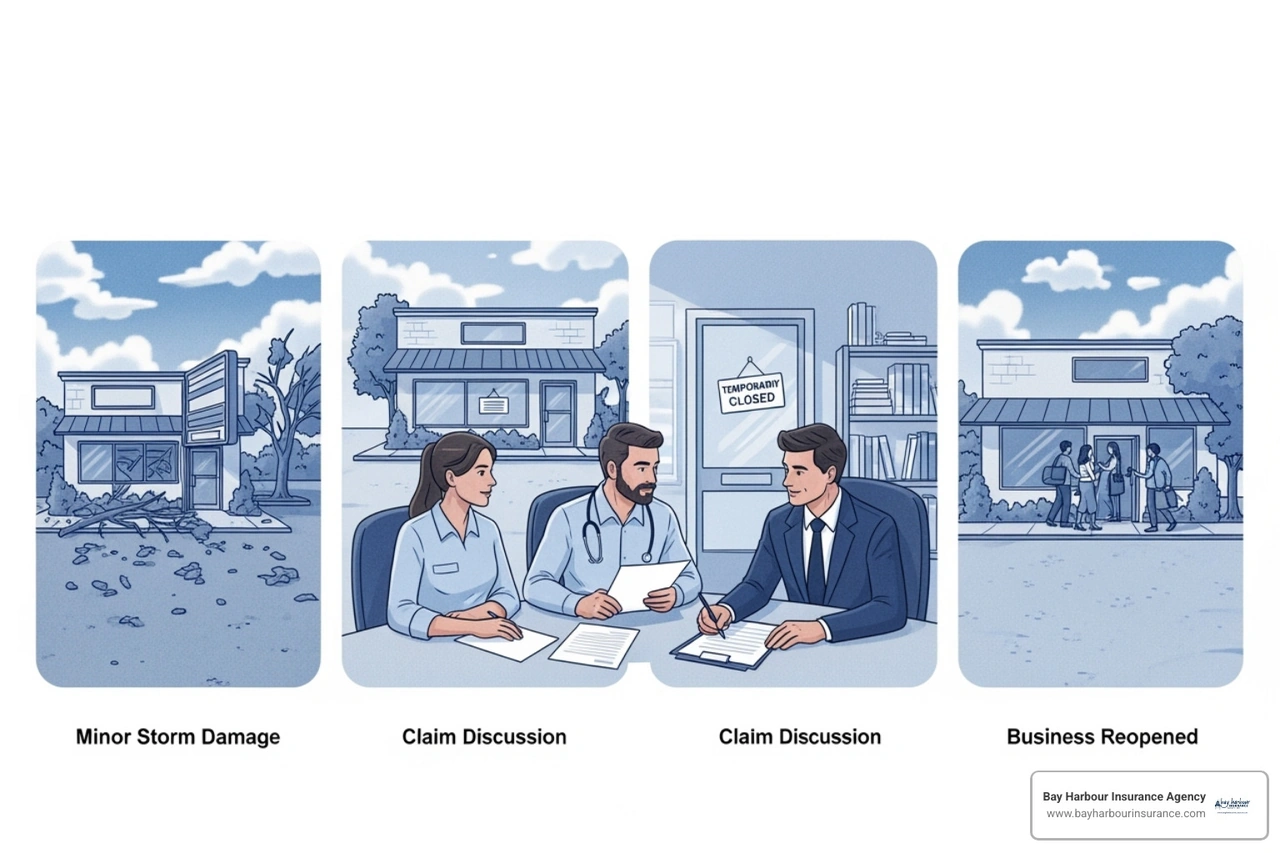
Think of what is business interruption insurance as a structured process to get your business back to the financial position it was in before a disaster. It's not a blank check; it operates under specific conditions.
The process is straightforward. First, a triggering event—actual physical damage to your property from a covered peril, like a fire in your Holtsville warehouse or a storm damaging your Holbrook storefront. This damage must force you to interrupt operations. After you file a claim, the insurer assesses your lost income and extra expenses based on your financial records. Once approved, the policy pays out to keep your Long Island business financially stable during restoration.
What Triggers a Business Interruption Claim?
The trigger is specific: direct physical loss or damage to your property from a peril covered by your property insurance. Slow sales or new competition don't count. If your property policy wouldn't cover the physical damage, your business interruption coverage won't activate.
Common triggers include fire, theft, vandalism, and wind damage. For example, a kitchen fire forces a Patchogue restaurant to close for weeks. Property insurance covers the physical repairs, but what about the lost revenue, staff payroll, and rent? That's the financial gap business interruption insurance is designed to fill, which is a crucial consideration for any restaurant owner in Medford or elsewhere on Long Island. For more on this, see our guide to Restaurant Insurance Coverage.
What Losses Are Typically Covered?
Once triggered, the policy covers several critical financial losses to keep your business stable:
- Lost Net Profits: Replaces the income you would have earned during the shutdown, based on historical data.
- Continuing Operating Expenses: Covers ongoing costs like utilities, advertising, and other overhead.
- Employee Payroll: Allows you to retain and pay your valuable team, a vital benefit for any business in Holbrook, Patchogue, or Medford.
- Rent or Mortgage Payments: Ensures you can meet property obligations even when closed.
- Taxes and Loan Payments: Covers commitments for property taxes, business loans, and equipment financing.
- Relocation Costs: Pays for moving to and operating from a temporary location, a key flexibility for a Holtsville business needing to get back up and running.
- Training for New Equipment: If new machinery requires staff training, these costs can be covered.
The goal is to restore your business to the financial position it would have been in if the disaster never occurred.
Understanding the "Period of Restoration"
The period of restoration is the timeframe during which your policy pays for losses. It begins after a short waiting period (typically 48-72 hours, like a time-based deductible) and lasts until your property is physically repaired and you can resume normal operations.
Here's a critical warning for business owners in Patchogue and across Long Island: standard policies often limit this period to just 30 days. For any significant repair, like after a major storm in Holbrook, 30 days is rarely enough time for assessments, permits, and construction.
We strongly recommend extended coverage endorsements, which can stretch the restoration period to 360 days or more. This gives you the breathing room to rebuild properly without your coverage running out before your doors reopen. This is a must-have for any serious business in Holtsville or Medford. For more on this calculation, the Insurance Institute offers resources on the Four Rules for Measuring the Business Interruption Period.
Common Exclusions and Policy Limitations
While what is business interruption insurance is powerful, understand what it does not cover. Knowing these limitations helps you manage expectations and identify gaps in your risk management plan for your Long Island business.

What is business interruption insurance not designed to cover?
Policies have clear boundaries. Here are common exclusions for businesses in Patchogue, Holbrook, and Medford:
- Undocumented Income: If you can't prove revenue with financial records, the insurer can't calculate your loss. Good bookkeeping is essential.
- Damage from Excluded Perils: If your property policy excludes floods or earthquakes, business interruption from those events is also not covered. This is a key consideration for any coastal Long Island business.
- Economic Downturns: Losses from a recession, market changes, or new competition are business risks, not insurable events.
- Permanent Closure: The policy is designed to help you reopen, not fund a decision to close for good.
- Supply Chain Issues (without physical damage): If a supplier's facility isn't physically damaged by a covered peril, standard policies won't cover your resulting losses. This is where contingent coverage becomes important for a business in Holtsville.
Special Cases: Pandemics and Civil Authority Orders
The COVID-19 pandemic highlighted a major limitation in most policies. The vast majority of claims from businesses in Patchogue and across Long Island were denied. The reason lies with two key elements:
- Virus and Bacteria Exclusions: Following the SARS outbreak, most policies added language specifically excluding losses from disease-causing agents.
- "Direct Physical Loss" Requirement: Viruses don't cause tangible property damage like a fire or storm. Courts have largely upheld that without this physical trigger, coverage doesn't apply. This issue is explored in-depth here: P&C Insurance: The Conundrum of Business Interruption Coverage during the Coronavirus Pandemic.
Civil Authority coverage is another provision with strict rules. It may apply if the government blocks access to your Holbrook or Holtsville business, but only if the order is due to physical damage to a nearby property from a covered peril. For example, a fire down the street in Medford causes the block to be cordoned off. However, coverage is often limited to just a few weeks and doesn't apply to general public health orders. Understanding these nuances is critical for realistic planning on Long Island.
Determining Your Coverage Needs and Costs
Business owners across Patchogue, Holbrook, Holtsville, and Medford often ask two key questions: "How much coverage do I need?" and "What will it cost?" The right amount of business interruption insurance must be custom to your unique Long Island business.
How is the amount of business interruption coverage determined?
Calculating your coverage needs is a methodical process, not guesswork. The goal is to ensure you can cover lost income and ongoing expenses for the entire time you might be closed. We use a structured approach:
- Analyze Financial Records: Your profit & loss statements and tax returns establish a baseline for your gross earnings and operating expenses.
- Project Future Profits: We look forward to account for growth or seasonality, which is critical for any growing business in Patchogue or Holbrook.
- Identify Continuing Expenses: We list every cost that continues during a shutdown, from rent and loan payments to key employee payroll.
- Factor in Extra Expenses: This includes potential costs to minimize the shutdown, like renting a temporary space in Holtsville or Medford.
Insurers provide business income worksheets to guide this calculation. Partnering with an experienced professional simplifies this complex but essential task. Our Specialized Insurance Agency in Patchogue, NY team helps Long Island business owners get this right. For a primer, see: Do I need business interruption insurance?
What Factors Influence the Cost of Your Policy?
Your premium reflects your specific risk profile. Key factors include:
- Industry Risk: A restaurant in Holbrook with fire hazards has a different risk profile than an office in Holtsville.
- Annual Revenue: Higher revenue requires higher coverage limits, which increases the premium.
- Number of Employees: Covering payroll for a larger workforce costs more.
- Property & Location: A coastal Patchogue business faces different risks than one inland in Medford. The value of your property also plays a role.
- Coverage Limits & Period: A 360-day indemnity period costs more than a standard 30-day period but provides far more security for a Long Island business.
- Claims History: Previous claims can increase your premium.
Beyond the Basics: Additional Coverages to Consider
Core business interruption insurance is the foundation, but additional endorsements create a truly comprehensive safety net for your Long Island business. These add-ons address specific, real-world disruptions you might face in Patchogue, Holbrook, or beyond.

What is business interruption insurance's key partner, Contingent Business Interruption?
Imagine your Holbrook business is fine, but your main supplier's warehouse in another state burns down. You can't get materials, and your revenue stops. This is where Contingent Business Interruption (CBI) insurance is essential. It protects you from losses caused by disruptions at properties you depend on but don't own, such as:
- Suppliers providing critical materials.
- Major Customers whose shutdown halts your sales.
- Contract Manufacturers who produce your goods.
- "Leader Locations" like an anchor store that drives traffic to your Medford retail shop.
In today's interconnected economy, CBI is vital for manufacturers in Holtsville or any business on Long Island with a critical supply chain. It acknowledges that your business doesn't operate in a vacuum. Learn more from Contingent Business Interruption: Getting All the Facts.
Other Essential Endorsements
Fine-tune your coverage with these key endorsements to fill gaps left by standard policies:
- Extra Expense Insurance: Covers additional costs to keep your business running after a loss, like renting a temporary office in Holtsville or paying employee overtime.
- Utility Services Coverage: Protects against income loss when damage to an off-site utility property (like a power substation) shuts down your operations. This is crucial for any business on Long Island.
- Ordinance or Law Coverage: If damage requires you to rebuild an older building to stricter modern codes, this covers the increased costs and the longer interruption period.
- Cyber Insurance with Business Interruption: A ransomware attack can shut down your Patchogue business as effectively as a fire. This specialized coverage protects against lost income and extra expenses from a cyber incident, a modern necessity. Learn about the Risks Without Cyber Insurance.
Secure Your Business's Future on Long Island
We've explored what is business interruption insurance—a vital tool that replaces lost income and covers expenses when disaster strikes. It works with property insurance but protects your financial health, not just your physical assets.
The reality for any Long Island business is clear. A storm can hit Patchogue, a fire can close your Holbrook location, or a power outage can paralyze Medford. When that happens, the right coverage is the difference between a temporary setback and permanent failure. 40% of businesses that close after a disaster never reopen.
Business interruption insurance is your financial lifeline. It keeps your employees paid, covers your rent, and gives you the breathing room to rebuild without going into debt. For businesses in Holtsville and across Long Island, it's what allows you to weather the storm and reopen your doors.
At Bay Harbour Insurance Agency, we specialize in protecting Long Island businesses. As an independent, client-centered agency, we understand the unique risks you face in Patchogue, Holbrook, Holtsville, and Medford. We're not tied to one carrier, so we can find the right coverage at the right price for your specific needs.
Don't wait for a disaster. The best time to secure your future is now.
Get a custom business insurance quote today and let's build a protection plan that keeps your Long Island business strong, no matter what comes your way.