

Why Calculating Home Insurance Matters More Than You Think
Calculating home insurance means figuring out how much coverage you need to protect your home and what you'll pay for it. Here's a quick overview:
Key Steps to Calculate Home Insurance:
- Estimate Replacement Cost - Multiply your home's square footage by the local rebuilding cost per square foot (which is higher on Long Island).
- Determine Dwelling Coverage - Should be at least 80% of your home's replacement value.
- Calculate Personal Property Coverage - Typically 50-70% of your dwelling coverage.
- Set Liability Coverage - Based on your net worth, usually $100,000-$500,000.
- Choose Your Deductible - A higher deductible means a lower premium.
- Add Endorsements - Consider flood, water backup, or other coverage for specific Long Island risks.
You've worked hard for your home in Patchogue, Holbrook, or Medford, but a sobering fact remains: about 64% of U.S. homes are underinsured. For homeowners across Long Island, this is a real risk. The cost to rebuild a home in New York is high due to steep labor and material costs. A generic estimate for your Holtsville home could leave you thousands short.
By understanding how to calculate your home insurance, you can ensure your coverage matches your reality. This guide walks you through every step of calculating home insurance for your Long Island home, from replacement cost to fine-tuning your policy. Whether you're in Holbrook, Holtsville, Medford, or Patchogue, you'll gain the knowledge to protect your New York home the right way.
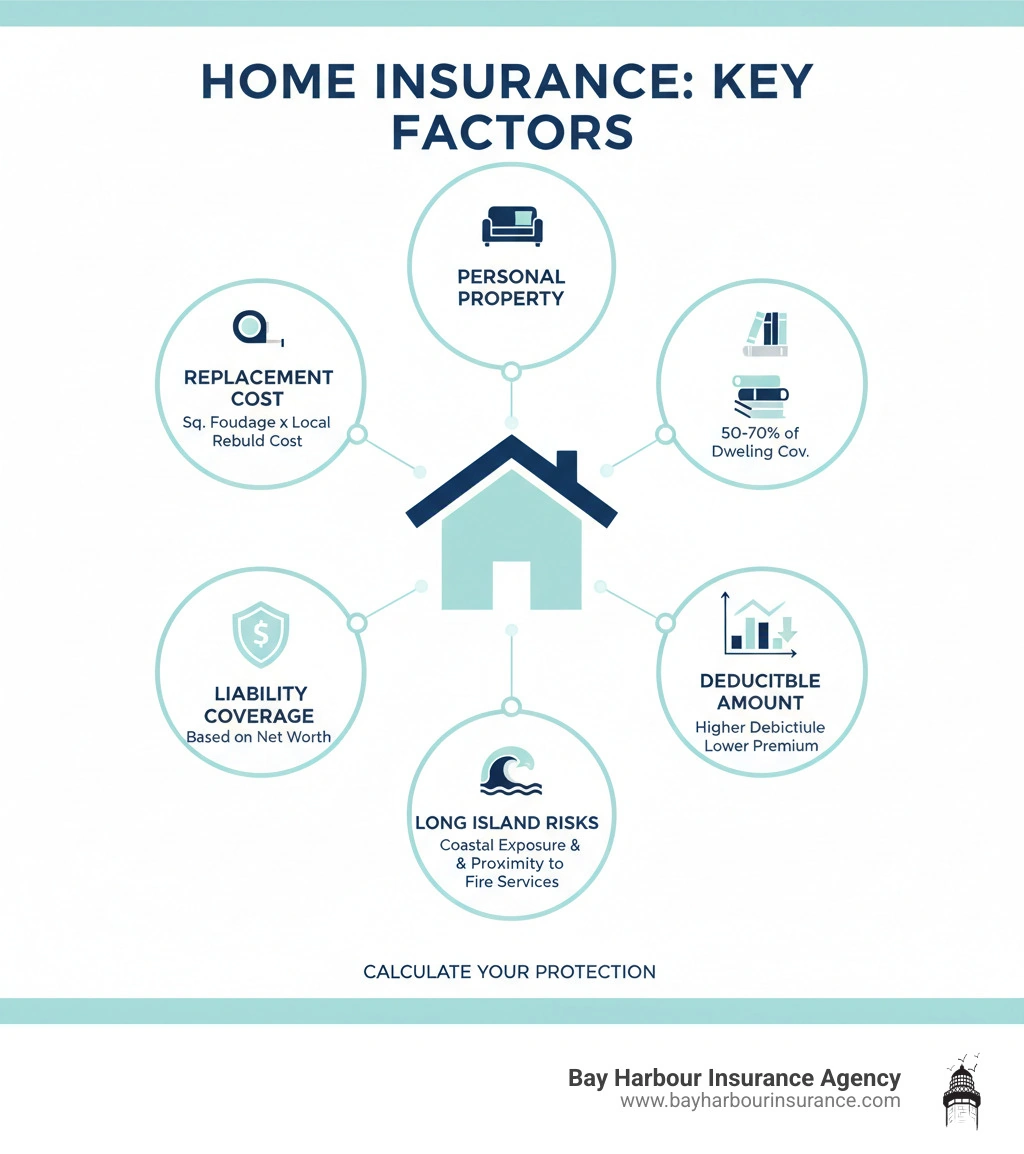
Calculating home insurance terms explained:
The Foundation: Calculating Your Home's Replacement Cost

When calculating home insurance, your home's replacement cost is the most critical number. It's the foundation of your dwelling coverage—the amount your insurer will pay to rebuild your home from scratch.
Many homeowners confuse replacement cost with market value. Market value includes land and location, while replacement cost is strictly the price of materials and labor to reconstruct your home. For Long Island homeowners, this distinction is vital. Rebuilding costs in New York are significantly higher than national averages. A generic estimate for your Patchogue or Holbrook home could leave you underinsured.
This is where the 80% rule is important. Most insurers require you to insure your home for at least 80% of its replacement value to get full coverage for a partial loss. Falling short means your insurer may only pay a proportional amount, leaving you with a large bill. This rule is a key reason so many homes are underinsured, a fate you want to avoid for your Medford property.
To understand this better, take a look at What is the 80% Rule in Homeowners Insurance? and More info about Insurance Valuation.
How to Estimate Your Home's Replacement Cost
A simple formula provides a solid starting point:
Square Footage × Local Rebuilding Cost Per Square Foot = Estimated Replacement Cost
National averages are irrelevant for homeowners in Holtsville, Medford, or anywhere on Long Island. Costs here are much higher due to New York's labor rates and building regulations. To get an accurate estimate, consider these variables:
- Construction Materials: Custom brick costs more than vinyl siding.
- Labor Costs: Skilled labor on Long Island commands premium rates.
- Upgrades & Quality: Unique architecture, custom woodwork, high-end appliances, and granite countertops all increase rebuilding costs.
- Age and Condition: Rebuilding an older Patchogue home may require costly updates to meet current building codes.
Your land's value is excluded from this calculation. Getting this number right for your home in Holtsville ensures peace of mind, knowing you won't face a massive financial gap if you need to rebuild.
Key Factors That Influence Your Home Insurance Premium
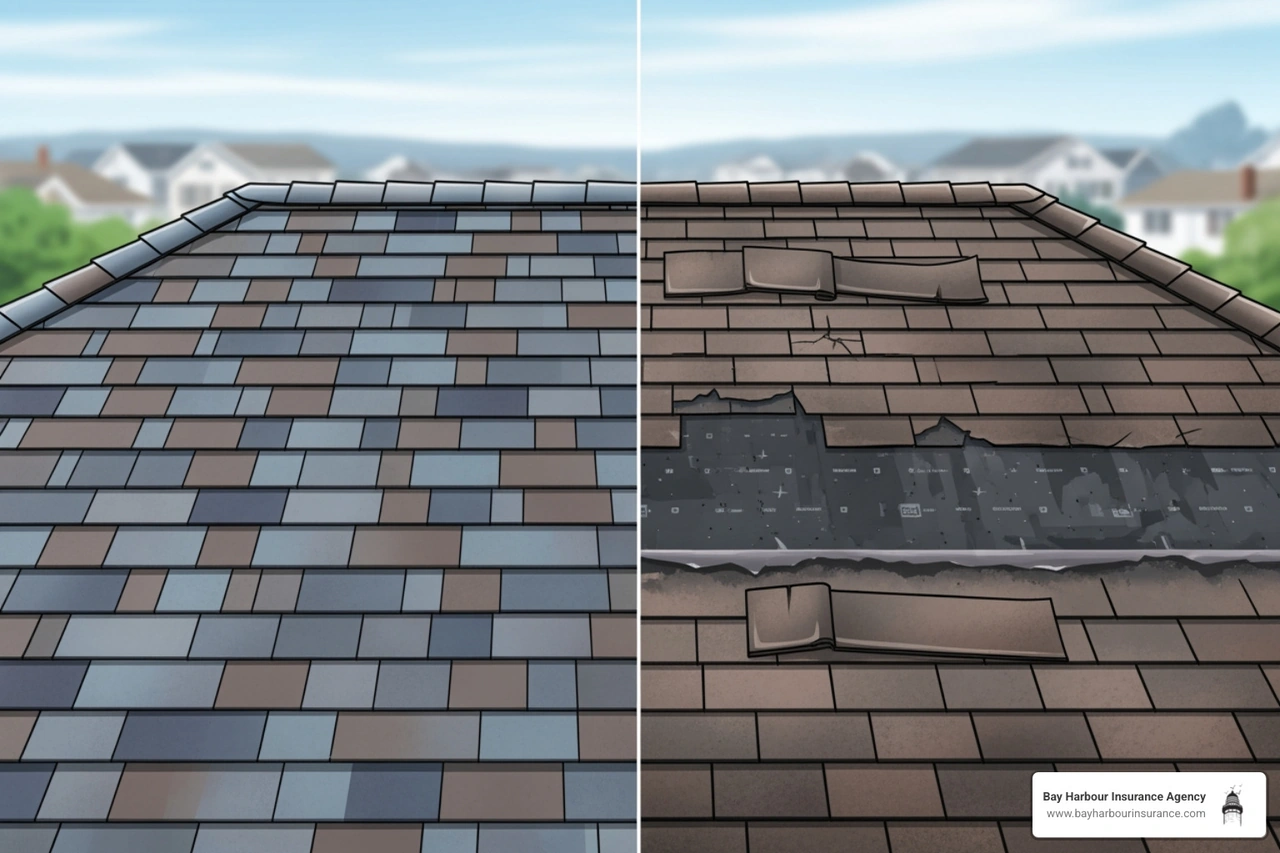
After determining replacement cost, the next step in calculating home insurance is understanding what drives your premium. Insurers assess your risk to price your coverage accurately. Key factors include your home's characteristics, location, and personal details.
Home Characteristics
- Age and Condition: An older Holbrook home with outdated wiring or plumbing poses a higher risk. However, recent updates to the roof, electrical, or plumbing systems in your Patchogue home can lead to discounts.
- Construction Materials: A brick home is more fire-resistant than a wood-frame one and often costs less to insure.
- Roof Age and Type: A new, impact-resistant roof will earn you better rates than an old, worn-out one.
- Home Systems: The condition of your heating, plumbing, and electrical systems is critical. An old furnace or corroded pipes are red flags for insurers.
Location-based Risks
Where your home is on Long Island matters immensely. Proximity to fire hydrants and stations in towns like Medford can lower your premium. Coastal risks are a major factor for any Holtsville home near the water, leading to higher rates and special deductibles for hurricanes. Insurers also use ZIP code data to assess neighborhood crime rates, which can affect your costs.
Personal Factors
- Claims History: A history of frequent claims will increase your premium. It's wise to ask about a property's claims history before buying a home in New York.
- Credit-Based Insurance Score: In New York, a strong credit history can result in lower insurance rates.
- Attractive Nuisances: Features like swimming pools and trampolines increase your liability risk and your premium. Having one at your Holbrook or Holtsville home means you'll need more liability coverage.
For a comprehensive look at how these factors affect homeowners across New York, check out Learn more about Homeowners Insurance in New York State. Understanding these variables helps you manage your coverage and costs in places like Medford and Patchogue.
Calculating Home Insurance Coverage for Your Life and Belongings

When calculating home insurance, you must also account for your belongings and financial liability. Personal property and liability coverage protect your possessions and your assets from lawsuits. Getting these numbers right is crucial for any homeowner on Long Island.
For a broader understanding of these coverage types, see our More info about Homeowners Insurance Basics.
How to Calculate Personal Property Coverage
Personal property coverage is typically set at 50% to 70% of your dwelling coverage. For a Holbrook home with $300,000 in dwelling coverage, that's $150,000 to $210,000 for your belongings. However, this default amount may not be enough. The only way to know for sure is to create a home inventory.
Go room by room, photographing and videoing everything you own. Note each item's description, purchase date, and replacement cost. This documentation is invaluable for a smooth claims process. The Insurance Information Institute provides great guidance on How to create a home inventory.
Be aware that standard policies have special limits for valuables like jewelry and art. If you own high-value items in your Medford or Patchogue home, you'll need a scheduled personal property endorsement to insure them for their full appraised value.
How to Calculate Personal Liability Coverage Needs
Personal liability coverage protects you if someone is injured on your property or if you cause damage to someone else's. Standard policies offer limits from $100,000 to $500,000, but is that enough for your Holtsville home?
The answer depends on your net worth. Your liability coverage should be high enough to protect all your assets—home equity, savings, investments—from a lawsuit. For many homeowners in Patchogue and across Long Island, a standard policy isn't sufficient.
If you have significant assets, consider an umbrella insurance policy. It provides an additional $1 million or more in liability protection once your homeowners limit is exhausted. For example, if a guest is seriously injured at your Holbrook home and sues for $800,000, but your liability limit is only $300,000, you'd be responsible for the $500,000 difference. An umbrella policy would cover that gap. Protecting your assets in New York means ensuring your liability coverage is up to the task, especially in high-value areas like Medford and Holtsville.
Fine-Tuning Your Policy and Premium

Now it's time to fine-tune your policy. When calculating home insurance costs, you must balance your annual premium with your out-of-pocket risk. For homeowners in Patchogue, Holbrook, and across Long Island, getting this balance right is key.
If you're concerned about weather risks in our area, Learn about the impact of hurricanes on insurance.
The Role of Deductibles in Calculating Home Insurance Premiums
Your deductible is what you pay on a claim before insurance kicks in. The trade-off is simple: a higher deductible lowers your premium, while a lower deductible means a higher premium. Choose a deductible you can comfortably afford to pay on short notice for your Holtsville home.
Consider this example for a typical Holbrook home:
(Note: These figures are illustrative examples only and do not represent actual pricing.)
Many Long Island homeowners are surprised by percentage-based deductibles for wind and hurricane damage. Common in New York, these are a percentage (typically 2-5%) of your dwelling coverage. For a Medford home with $400,000 in coverage and a 2% hurricane deductible, your out-of-pocket cost would be $8,000.
Optional Riders and Endorsements to Consider
A standard policy has gaps. Endorsements customize your policy for specific risks on Long Island.
- Flood Insurance: Standard policies do not cover floods. This is crucial coverage for any home in Patchogue or near the water in Medford and is often purchased separately.
- Water Backup Coverage: Protects against damage from backed-up sewers or failed sump pumps, a common issue in New York during heavy rains.
- Scheduled Personal Property: Insures high-value items like jewelry or art for their full appraised value.
- Extended/Guaranteed Replacement Cost: Provides a cushion (e.g., 25% extra) above your dwelling limit to cover unexpected spikes in building costs, vital for rebuilding in Holbrook.
- Building Code Coverage: Pays the extra cost to bring an older home up to current building codes after a loss.
Customizing your policy with the right endorsements ensures you're fully protected. An agent who understands the risks in Holtsville and across Long Island can provide essential guidance.
From Estimate to Official Quote: How to Get Your Personalized Rate

You've done the research. Now it's time to turn your estimates into a personalized quote for your Holbrook, Holtsville, or Medford home. While online calculators offer a quick ballpark figure, they are too generic for an accurate quote.
These tools can't account for the specific details of your Patchogue home, like custom renovations, a new HVAC system, or a claims-free history. When calculating home insurance for real, these details matter. To get an official quote, insurers need specifics: your home's age, construction materials, upgrades, safety features, and desired coverage limits.
This is where an independent insurance agent provides immense value. Unlike captive agents, we at Bay Harbour Insurance Agency shop your coverage across multiple carriers to find the best fit for your Long Island home. We take the time to understand your needs, explain policies clearly, and find all available discounts. Because we're local to New York, we understand the unique risks in Holbrook and Holtsville, from coastal storms to high rebuilding costs.
Our personalized guidance means you get the right coverage at the right price for your Medford home. For more ways to optimize your costs, see our Tips on how to save money on home insurance in NY.
Frequently Asked Questions about Calculating Home Insurance
Why did my home insurance premium increase this year?
Many homeowners in Patchogue, Holbrook, and across Long Island see their premiums rise. This is common in New York for a few reasons:
- Inflation: The cost of building materials and labor has soared. As it costs more to rebuild your Holtsville home, your coverage and premium must increase.
- Increased Local Claims: Severe weather on Long Island leads to more claims. Insurers spread these costs across all policyholders in the region.
- Changes to Your Home's Risk: As a home ages, so do its systems (roof, plumbing, electrical), increasing the risk of a claim. This can affect premiums for homes in Medford and elsewhere.
How much liability coverage is enough?
When calculating home insurance, a good rule is to carry enough liability coverage to protect your total net worth (savings, investments, home equity). Standard limits often start at $100,000, but we recommend a minimum of $300,000 to $500,000. For many homeowners in Patchogue and Holtsville with significant assets, even this isn't enough. An umbrella insurance policy, which adds $1 million or more in protection, is a necessary safeguard for protecting your wealth on Long Island.
What is the difference between Actual Cash Value (ACV) and Replacement Cost (RCV)?
This distinction is critical and can mean a difference of thousands of dollars after a loss.
- Replacement Cost (RCV): Pays to replace damaged items with new ones of similar quality, with no deduction for depreciation. If a fire destroys your 10-year-old cabinets, RCV pays for new ones. We always recommend RCV.
- Actual Cash Value (ACV): Pays the replacement cost minus depreciation. For those same 10-year-old cabinets, you'd only get a fraction of the cost of new ones. ACV policies are cheaper but can leave you underfunded.
For homeowners in Medford, Holbrook, and across New York, RCV coverage is the best way to ensure you can fully recover after a loss.
Your Partner in Protection on Long Island
We hope this guide has demystified the process of calculating home insurance. By understanding replacement cost, personal property needs, and liability limits, you can take control of your coverage and avoid being underinsured.
An accurate calculation ensures your home in Patchogue, Holbrook, or Holtsville is truly protected. Every home on Long Island is unique and deserves more than a one-size-fits-all policy. Your home in Medford or anywhere in New York needs personalized attention from a local expert who understands the risks.
That's where we come in. At Bay Harbour Insurance Agency, we are your neighbors. As an independent agency, we work for you, shopping multiple carriers to find the right coverage at the right price. We provide honest, jargon-free guidance to protect what matters most to you and your family in Patchogue, Holbrook, or Holtsville.
Ready to ensure your Long Island home is properly protected? Let's have a conversation.
Get a comprehensive review of your New York homeowners insurance needs and experience what personalized, client-centered service really means.