

Introduction
Insurance retirement products—principally fixed, indexed, and immediate annuities along with cash-value life insurance—build steady income for life by transferring longevity and market risk to insurers through contractually guaranteed lifetime payouts and downside principal protection. For families across Long Island, from quiet neighborhoods in Patchogue to tree-lined streets in Holbrook, these structures create a predictable income floor that market swings cannot erode.
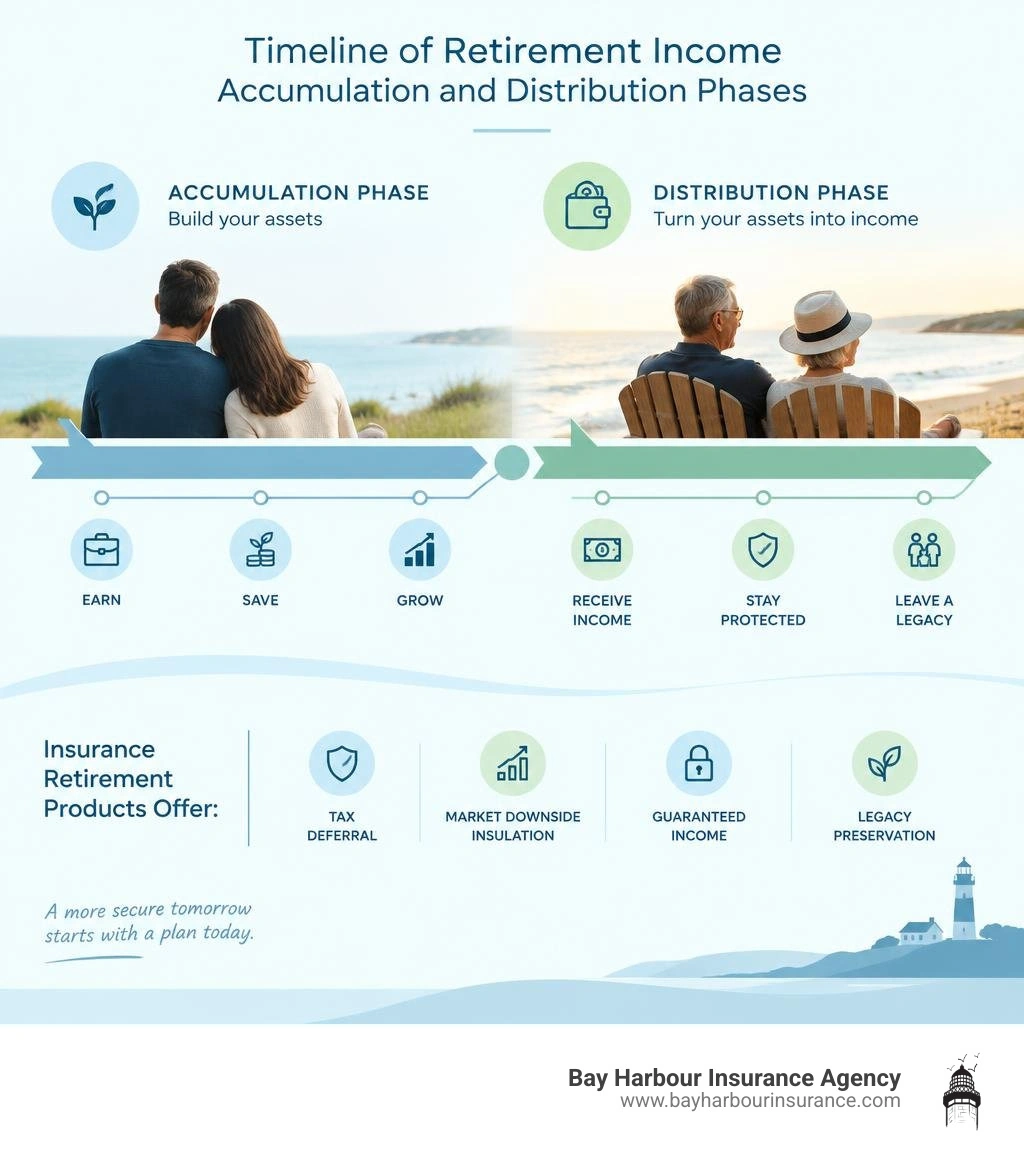
Retirement unfolds in two distinct stages: the accumulation phase, where you build assets, and the distribution phase, where you convert those assets into dependable cash flow. While traditional investment portfolios carry the risk of market downturns right when you need withdrawals, insurance-backed strategies offer structured guarantees designed to absorb economic turbulence.
Evaluating Core Insurance Retirement Products for Long-Term Wealth
The primary challenge in modern retirement planning is replacing a regular paycheck without taking excessive risks. Insurance retirement products provide a structural bridge by offering tax deferral, market downside insulation, guaranteed income, and legacy preservation.
Guaranteed Annuities for Lifetime Income Streams
Annuities operate as personal pensions. When you purchase an annuity, you transfer longevity risk—the danger of outliving your capital—to an insurance carrier. The insurer pools risks across thousands of policyholders, utilizing mortality credits to pay a guaranteed income stream for as long as you live.
For retirees in Holtsville and working professionals in Medford planning their golden years, establishing an income floor covers essential living expenses like property taxes, groceries, and utilities. Contract guarantees depend entirely on the claims-paying ability of the issuing insurer, making institutional strength paramount. Exploring structured retirement annuities allows you to turn a portion of your nest egg into guaranteed monthly cash flow that continues regardless of market conditions.
Cash-Value Life Insurance and LIRP Strategies
A Life Insurance Retirement Plan (LIRP) uses permanent life insurance—such as whole life or indexed universal life—as a supplemental wealth accumulation vehicle. Unlike term insurance, permanent policies contain a cash-value account that grows tax-deferred.
In a properly funded LIRP, you build cash value during your working years and access it during retirement via tax-free policy loans and basis withdrawals. For high-earning households in Holbrook and Patchogue who have already maximized their qualified accounts, a LIRP provides a non-correlated asset class that can supply cash during market downturns, protecting primary investment portfolios from forced liquidations.
Comparing Annuity Types: Structures, Payouts, and Growth Potential
Annuity contracts are not one-size-fits-all. They vary widely in how interest is credited, how payouts are structured, and the level of investment risk involved. Reviewing regulatory guidance from FINRA on annuity structures and investor risks helps demystify these financial vehicles.
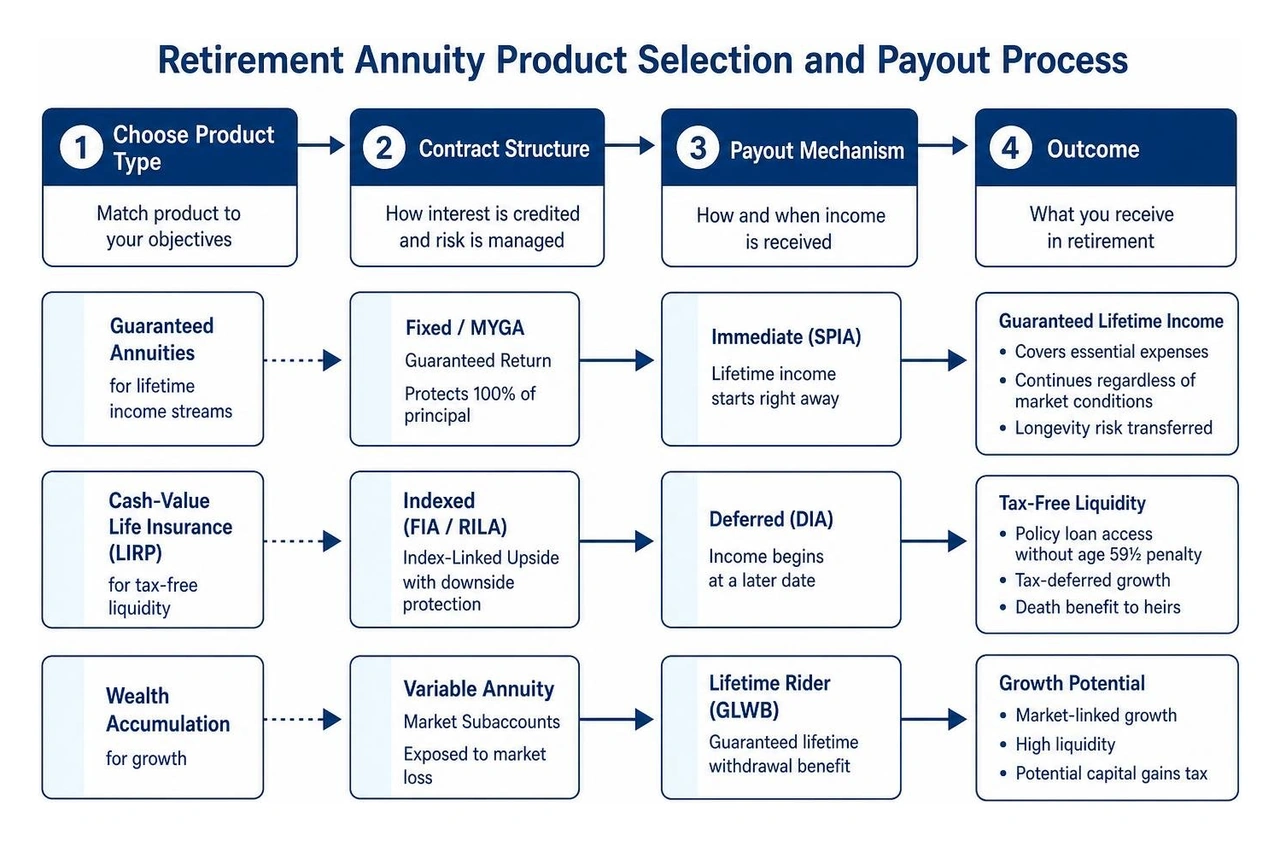
Comparing Fixed, Indexed, and Variable Insurance Retirement Products
Understanding the core product designs allows you to match contracts with your risk tolerance:
- Fixed Annuities (MYGAs): Multi-Year Guaranteed Annuities operate much like bank certificates of deposit, offering a fixed, guaranteed interest rate for a period ranging from 3 to 10 years. They protect 100% of principal.
- Fixed Indexed Annuities (FIAs): These contracts credit interest based on the performance of an underlying market index (such as the S&P 500), subject to participation rates and caps. If the index drops, your principal remains protected with a 0% floor, ensuring you never lose money due to market declines.
- Variable Annuities: Your funds are invested directly in market subaccounts consisting of stocks and bonds. While they offer the highest growth potential, they expose your principal to downside market risk and carry higher annual management fees.
- Registered Index-Linked Annuities (RILAs): Often referred to as structured annuities, RILAs offer a hybrid approach using downside buffers (e.g., absorbing the first 10% to 20% of market losses) in exchange for higher upside caps.
To evaluate custom growth allocations and contract options, you can review options from Guardian's retirement solutions or compare indexed options through SILAC annuity products and Ameriprise Financial annuities.
Immediate vs. Deferred Payout Structures
Payout timing separates immediate annuities from deferred models:
- Single Premium Immediate Annuities (SPIAs): Funded with a single lump sum, payouts begin within 1 to 12 months. This structure is ideal for individuals retiring immediately who need to replace workplace income.
- Deferred Income Annuities (DIAs): Payouts are delayed for years or decades, allowing the underlying cash balance to compound tax-deferred before conversion into an income stream.
In high-cost regions like New York, immediate structures hedge against sequence-of-returns risk—the danger of suffering market drawdowns in the earliest years of retirement—by locking in predictable cash flow from day one. You can model lifetime distributions with tools from Americo retirement solutions or examine guaranteed income products via New York Life retirement plans.
Integrating Life Insurance Retirement Plans with Traditional 401(k) and IRA Accounts
A resilient retirement plan incorporates multiple tax buckets: taxable (brokerage accounts), tax-deferred (traditional 401(k)s and IRAs), and tax-free (Roth IRAs, Health Savings Accounts, and cash-value life insurance).
Tax Advantages and Policy Loan Mechanics
Permanent life insurance receives distinct treatment under Internal Revenue Code Section 7702. When you withdraw money, it is treated on a First-In, First-Out (FIFO) basis, meaning you withdraw your principal tax-free first. Once basis is recovered, you access accumulated gains via collateralized policy loans, which do not trigger income tax events.
To maintain these tax benefits, policies must remain funded within statutory guidelines to avoid becoming a Modified Endowment Contract (MEC). If a policy becomes a MEC, loans are taxed on a Last-In, First-Out (LIFO) basis and incur a 10% IRS penalty if taken prior to age 59½. Working with experienced advisors to structure policy loans ensures you avoid policy lapses that could trigger unexpected taxes. You can learn more about asset coordination through New York Life retirement insights.
Term vs. Permanent Coverage for Retirement Planning
As of 2024, only 50% of Americans owned any form of life insurance, down from 63% in 2011. Among Gen Z, ownership drops to 36%. Furthermore, nearly three-quarters of Americans significantly overestimate the actual cost of life insurance.
Term life insurance provides straightforward, low-cost death benefit protection for a set timeframe (such as 20 or 30 years) to cover mortgage liabilities and income replacement during working years. Permanent life insurance, while requiring higher premiums, offers lifetime coverage, cash-value growth, and estate liquidity to pay final expenses or estate taxes. Aligning these tools with your retirement plan ensures your family is protected during wealth accumulation while leaving options open for retirement transfers.
Mitigating Healthcare Risks with Long-Term Care Solutions

A comprehensive retirement strategy must address healthcare and custodial expenses. The national average cost for a semi-private room in a nursing home reaches $8,200 per month, while assisted living facilities average over $4,600 per month. Without adequate planning, extended healthcare events can quickly deplete a lifetime of retirement savings.
Selecting Hybrid Insurance Retirement Products for Long-Term Care Protection
Traditional standalone long-term care (LTC) insurance often suffers from "use-it-or-lose-it" dynamics and unpredictable premium increases. In response, asset-based hybrid policies have become an effective alternative for families across Long Island.
Hybrid life and annuity products combine long-term care riders with an underlying life insurance policy or annuity base. If you require qualifying care, the policy accelerates the death benefit or annuity balance to pay for home health aides, assisted living, or nursing home care. If you never need care, the full death benefit passes to your beneficiaries tax-free. To review hybrid models, explore specialized guidance from Snyder Wealth Group on long-term care.
Qualifying Triggers and Distribution Rules
To activate benefits under a long-term care rider, a licensed healthcare practitioner must certify that the insured cannot perform at least two of the six Activities of Daily Living (ADLs)—bathing, dressing, eating, transferring, toileting, and continence—or requires substantial supervision due to severe cognitive impairment.
Benefits are distributed using two primary models:
- Reimbursement Model: The insurer reimburses exact, itemized receipts from licensed care providers up to your monthly maximum benefit limit.
- Indemnity Model: The insurer pays out the contract’s full monthly benefit amount directly in cash once claim criteria are met, regardless of actual expenses incurred, providing complete flexibility for family caregiving arrangements.
Insurer Financial Strength, Safety Ratings, and Professional Guidance
Because insurance retirement products are long-term contracts spanning decades, the financial stability of the issuing carrier is essential. Independent rating agencies evaluate insurers based on balance sheet strength, operating performance, and claims-paying history:
- A.M. Best: Ratings range from A++ (Superior) down to D. Notably, top networks like Fidelity maintain annuity provider platforms where carriers hold an A+ or A++ rating—a distinction achieved by less than 5% of rated life and health insurers.
- Standard & Poor’s (S&P): Evaluates insurers on a scale from AAA to CC.
- Moody’s and Fitch: Provide complementary credit ratings measuring creditworthiness and systemic resilience.
Avoiding Common Product Pitfalls and Debunking Misconceptions
Misunderstandings often surround annuities and cash-value life insurance. Addressing these misconceptions ensures smart decision-making:
- Misconception 1: "The insurance company keeps my money when I die."Reality: While simple single-life annuitization historically forfeited remaining balances upon death, modern annuities offer cash-refund riders, joint-and-survivor payouts, and period-certain options that ensure remaining assets pass directly to named beneficiaries.
- Misconception 2: "Annuity and life insurance fees always destroy returns."Reality: While variable products contain mortality and expense charges, fixed and indexed annuities often carry zero base management fees unless optional lifetime income or long-term care riders are added.
- Misconception 3: "All my money is locked away forever."Reality: Most deferred contracts allow penalty-free annual withdrawals of 10% of the account value after the first year, providing ongoing liquidity during the surrender period.
Tailoring Strategies for Local New York Retirees
Retirement planning in New York requires careful navigation of state tax laws, cost-of-living realities, and specific insurance department regulations. Coordinating personal assets across Long Island ensures that personal properties, savings, and investments work together smoothly.
Balancing property and liability protection with your long-term wealth strategy is vital. To make sure your overall asset base is insulated from unforeseen liabilities, explore how personal insurance planning in Patchogue, NY safeguards your home and personal wealth alongside your broader retirement roadmap.
Frequently Asked Questions About Insurance Retirement Products
Can pre-tax IRA funds be used to purchase an annuity?
Yes. You can execute a direct rollover or transfer from an existing traditional IRA or 401(k) into a "qualified annuity" without triggering income taxes or penalties. The funds maintain their tax-deferred status inside the annuity contract. However, because the annuity is funded with pre-tax dollars, all future income distributions will be taxed as ordinary income, and you remain subject to IRS Required Minimum Distribution (RMD) rules starting between ages 73 and 75.
How are cash withdrawals and policy loans taxed in retirement?
Non-qualified annuities follow a Last-In, First-Out (LIFO) tax model, meaning all interest and investment gains are withdrawn first and taxed as ordinary income before you can access your tax-free principal. In contrast, cash-value life insurance functions on a First-In, First-Out (FIFO) basis for direct withdrawals, and subsequent policy loans are non-taxable as long as the policy remains in force. If a policy lapses with outstanding loans exceeding the cash basis, the unpaid loan balance becomes immediately taxable as ordinary income.
What age is ideal for establishing an insurance-based retirement strategy?
For cash-value life insurance, starting in your 30s, 40s, or early 50s provides the compounding runway needed to build substantial cash values while securing lower insurance costs. For deferred annuities, pre-retirees between ages 50 and 65 often purchase contracts to lock in guaranteed growth and income floors ahead of retirement. Immediate annuities are generally best suited for individuals aged 65 and older who are ready to convert accumulated capital into steady cash flow immediately.
Conclusion
Building a secure, lasting retirement requires blending asset growth with risk-managed stability. By integrating annuities for lifetime guaranteed income, cash-value life insurance for tax-advantaged liquidity, and hybrid long-term care riders to protect against medical inflation, you can create a comprehensive financial strategy tailored to your lifestyle.
For families across Long Island, our team at Bay Harbour Insurance Agency is committed to helping you protect what matters most. As an independent, client-centered agency serving Patchogue, Holbrook, Holtsville, and Medford, we deliver personal service and objective guidance to safeguard your assets at every stage of life.
Whether you are evaluating coverage to protect your estate or securing comprehensive personal insurance quotes across Long Island, reach out to us today to ensure your family's future is grounded in lasting financial security.