

Why Startup Business Insurance is Your First Strategic Investment
Startup business insurance is a collection of policies designed to protect new and growing companies from financial losses due to lawsuits, property damage, cyber-attacks, employee injuries, and other unexpected events that could otherwise derail your business.
Essential Startup Insurance Types:
- Commercial General Liability (CGL) - Covers third-party injuries, property damage, and advertising injury claims
- Errors & Omissions (E&O) - Protects against claims of mistakes or negligence in your services
- Cyber Liability - Covers data breaches and ransomware attacks
- Workers' Compensation - Mandatory in New York for businesses with employees; covers medical expenses and lost wages
- Directors & Officers (D&O) - Protects leadership from personal liability, often required by investors
Launching a startup in Patchogue, Holbrook, or anywhere on Long Island is thrilling. You've got a vision, a business plan, and the drive to make it happen. But here's what many first-time founders in Medford and Holtsville overlook: insurance isn't a luxury you add later. It's a strategic asset you need from day one.
Research shows that two out of every three repeat startup founders make insurance an integral part of their early growth plans. Why? Because they've learned the hard way. Without proper coverage, a single lawsuit, data breach, or workplace injury can drain your limited capital and force you to shut down—even if your business model is solid.
In New York, some insurance types are legally required. Workers' compensation is mandatory if you have employees. Many commercial leases on Long Island require proof of general liability coverage before you can sign. Clients—especially larger ones—often won't contract with startups that lack adequate insurance.
But beyond compliance, insurance builds trust. It shows investors, partners, and clients that you're serious, professional, and prepared for the unexpected. It transfers risk away from your personal assets and your company's limited cash reserves. It protects everything you're working to build in Holtsville, Patchogue, and beyond.
This guide will walk you through exactly what coverage you need, when you need it, and how to assess your risks as a Long Island entrepreneur. We'll cover the essentials every startup requires, specialized policies for scaling companies, and practical strategies for managing costs without leaving gaps in your protection.
Why Insurance is a Strategic Asset for Your New York Startup
As entrepreneurs, we pour our hearts and souls into our ventures. We dream big, innovate, and strive to create something impactful. But even the most brilliant idea can crumble under the weight of unforeseen challenges. This is where startup business insurance steps in, changing from a mere expense into a pivotal strategic asset for your New York venture. It's not just about protection; it's about enabling growth, fostering trust, and ensuring the longevity of your Medford business.
Consider this: nearly 99% of companies in Canada are small- or medium-sized businesses, and the landscape in the US, especially here on Long Island, is similar. These businesses, including our own, are the backbone of the economy, yet they are inherently vulnerable. Startups, with their often-limited liquid funds and nascent operational structures, are particularly susceptible to major financial burdens without adequate insurance. We’ve seen how a single, unexpected event—a lawsuit, a data breach, or even a natural disaster—can devastate a promising new company. Insurance safeguards your financial future, ensures legal compliance, builds crucial client trust, and acts as a robust risk transfer mechanism, allowing you to focus on what you do best: innovating and growing. For more insights on how to protect your business, explore our Business Owner Protection guide.
Financial Protection and Risk Transfer
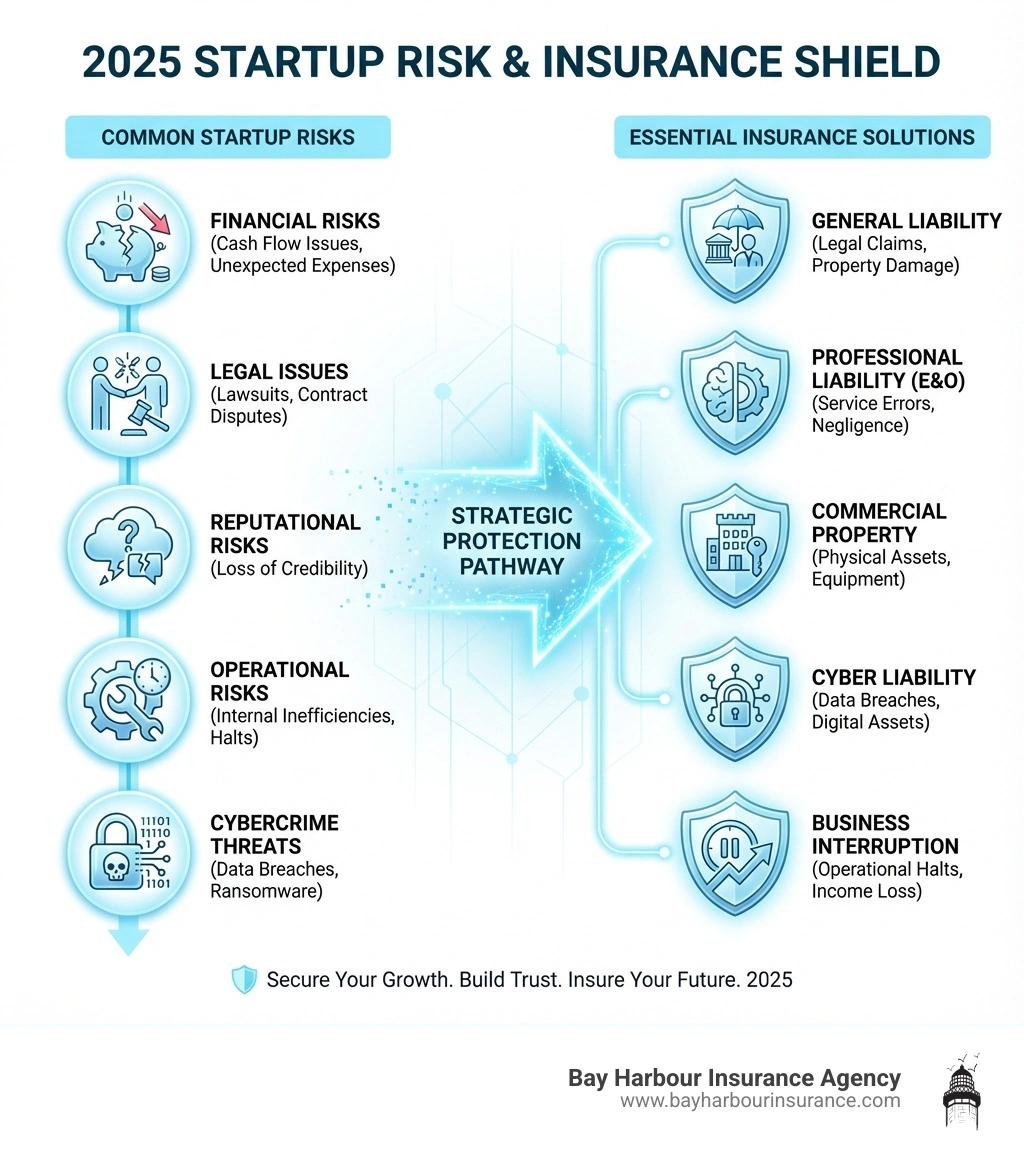
Imagine building your dream company in Patchogue, only to face a crippling lawsuit or unexpected property damage. Without startup business insurance, these financial blows could mean the end of your journey. Insurance provides a crucial safety net, protecting your venture from the myriad of risks that can lead to significant financial loss. Common risks that startups face include:
- Financial risks: Inadequate cash flow, unexpected operational expenses, and the high costs associated with litigation.
- Legal issues: Lawsuits alleging negligence, breach of contract, or even intellectual property infringement.
- Reputational risks: Loss of credibility or public trust due to service failures or data breaches.
- Market risks: Challenges related to market acceptance or competitive pressures.
- Operational risks: Internal process inefficiencies, equipment failures, or supply chain disruptions.
- Cybercrime: Data theft, ransomware attacks, and other digital threats that can compromise sensitive information.
These scenarios aren't just theoretical; they're real-world threats. A startup's products not working as promised can lead to client lawsuits alleging professional liability or negligence. An unexpected fire could destroy your equipment and inventory. In such cases, insurance acts as a powerful risk transfer mechanism. Instead of bearing the full financial burden ourselves, we transfer that risk to an insurance provider. This doesn't just protect our company's assets; it shields our personal finances, offering peace of mind and allowing us to focus on growth. For a deeper understanding of how we can protect your investments, consider our insights on Insurance Valuation.
Legal Compliance and Building Trust
Operating a business in New York comes with its share of responsibilities, and legal compliance is paramount. While most states don't mandate standard commercial insurance, specific coverages, like workers' compensation, become legally required once you hire employees. Moreover, many commercial landlords on Long Island will require proof of general liability insurance before you can lease office space. Ignoring these requirements isn't just risky; it can lead to hefty fines and legal complications.
Beyond legal obligations, having the right startup business insurance is a powerful tool for building client trust and enhancing your reputation. In today's competitive market, clients, partners, and investors scrutinize every aspect of a startup. A comprehensive insurance policy demonstrates professionalism and legitimacy. Clients may be hesitant to sign a contract with a startup if it lacks adequate coverage, viewing it as a sign of instability or lack of preparedness. For example, a larger client might insist on specific liability coverages before engaging your services. By having insurance, you signal that you're a serious, responsible entity capable of mitigating risks, making your Holtsville startup more attractive to potential partners and securing larger contracts.
The Core Insurance Portfolio: Your Startup Business Insurance Foundation
Every great structure needs a solid foundation, and your startup is no different. Just as you carefully select your team and refine your product, establishing a core insurance portfolio is fundamental to protecting your assets and operations. These foundational coverages are the bedrock of your startup business insurance strategy, designed to address the most common and potentially devastating risks faced by new businesses. While specific needs may vary, these policies form the essential starting point for any business, whether you're a burgeoning tech firm in Holbrook or a boutique storefront in Patchogue. We can help you customize these policies to fit the unique needs of your business. To learn more about comprehensive business insurance options, visit our main business insurance page.

Commercial General Liability (CGL) Insurance
Commercial General Liability (CGL) insurance is often considered the first line of defense for any business, especially for startups. This policy protects your company from claims of bodily injury, property damage, and personal and advertising injury (like libel or slander) that occur as a result of your business operations. Think of it as your primary shield against the everyday hazards of doing business.
For a startup on Long Island, CGL is essential if you interact with clients, customers, or the public, or if you operate from a physical location. A common scenario is a "slip-and-fall" accident on your premises, leading to medical bills and potential lawsuits. CGL would cover the associated legal fees, medical expenses, and settlements. It also provides coverage if your operations cause damage to someone else's property. Many commercial leases and B2B contracts require at least $2 million in liability coverage, making CGL a non-negotiable part of your startup business insurance plan. To understand the specifics of CGL in New York, refer to our General Liability Insurance NY guide.
Errors & Omissions (E&O) / Professional Liability
If your startup provides advice, services, or technical expertise, Errors & Omissions (E&O) insurance, also known as Professional Liability, is non-negotiable. This critical coverage protects your business against claims of financial loss experienced by a client due to an error, omission, or negligence in the professional services you provide.
For tech startups, consulting firms, marketing agencies, or any service-based business in Medford, E&O is paramount. If a client alleges that your advice led to their financial detriment, or if a software bug causes operational issues for a customer, E&O insurance would cover your legal defense costs, settlements, and judgments, even if the claim is unfounded. For software startups, E&O coverage functions much like product liability, protecting against the unique risks associated with code and digital services. As the saying goes, "Can anything my business does—or fails to do—harm a client?” If the answer is yes, E&O insurance is non-negotiable for New York startups.
Cyber Liability Insurance
In our increasingly digital world, Cyber Liability Insurance has become an absolute necessity, particularly for startups in Holtsville and across New York. If your business collects, stores, or transmits sensitive customer data—be it personal information, financial details, or health records—you are a prime target for cybercriminals. Cybercrime is a rising risk factor with significant implications for businesses of all sizes.
A data breach can be catastrophic for a startup, leading to not only financial losses but also severe reputational damage. Cyber Liability insurance covers the costs associated with responding to a breach, including forensic investigations, customer notification expenses, credit monitoring services, public relations efforts to restore your reputation, legal fees, and potential regulatory fines. For e-commerce and on-demand startups, protecting customer data from cybercriminals should be a top priority. Stories of startups forced to shut down after massive cyberattacks are grim reminders of this growing threat. Don't let your digital dreams turn into a cyber nightmare; understand the Risks Without Cyber Insurance and secure your business.
Workers’ Compensation Insurance
As your startup grows and you begin hiring employees in New York, Workers' Compensation Insurance becomes a legal requirement. This mandatory coverage provides benefits to employees who suffer work-related injuries or illnesses, covering their medical expenses, lost wages during recovery, and rehabilitation costs. It also protects your business from direct lawsuits by employees over these injuries.
For any growing team in Patchogue, workers' compensation is a cornerstone of responsible business ownership. It ensures that your employees are cared for if they get hurt on the job, fostering a safe and supportive work environment. The laws surrounding workers' compensation can be complex and vary by state. We recommend consulting with local experts to understand your specific obligations. You can also contact the New York State Department of Labor to find out your coverage requirements.
Scaling Your Shield: Advanced and Specialized Coverages
As your startup evolves from a fledgling idea into a thriving enterprise, your insurance needs will evolve too. Reaching new milestones, such as hiring more employees or securing significant investment rounds, often introduces new layers of risk and corresponding insurance requirements. This phase is about scaling your shield, ensuring your startup business insurance adapts to protect your growing assets, expanding team, and increasing responsibilities. Whether your Holbrook business is expanding its services or attracting venture capital, tailoring your coverage becomes crucial.

Directors & Officers (D&O) Insurance
Once your startup establishes a board of directors, attracts outside investors, or even approaches venture capital funding, Directors & Officers (D&O) insurance often becomes a critical requirement. This policy protects the personal assets of your company's leaders—directors, officers, and sometimes even key employees—from lawsuits alleging wrongful acts in their management capacity.
D&O cases can involve claims of breach of fiduciary duty, misrepresentation, mismanagement of funds, or even decisions that negatively impact shareholders or stakeholders. These lawsuits can be incredibly costly to defend, and without D&O coverage, the personal assets of your leadership could be at risk. Investors frequently mandate D&O insurance as a condition for funding on Long Island, as it protects their investment by safeguarding the individuals responsible for guiding the company. Understanding the Directors & Officers Insurance Basics is crucial for any startup with aspirations for significant growth and external funding.
Employment Practices Liability (EPLI)
Hiring your first employees is an exciting step, but it also opens your startup to a new category of risk: employment-related claims. Employment Practices Liability Insurance (EPLI) is designed to protect your business from lawsuits filed by employees over issues such as wrongful termination, discrimination, harassment, retaliation, or wage disputes.
Statistics show that nearly 40% of US companies face an employment-related lawsuit over five years. This highlights just how common these claims are, even for small businesses. For a startup in Medford, where formal HR departments might be nascent or non-existent, the risk of missteps can be higher. EPLI provides crucial financial protection, covering legal defense costs, settlements, and judgments. It shields your startup from HR-related claims, allowing you to build and manage your team with greater confidence. While the provided link points to a Canadian resource, the principles of Employment Practices Liability Insurance are universally important for protecting your growing team.
Business Owner's Policy (BOP)
For many small and medium-sized startups in Holtsville and Patchogue, a Business Owner's Policy (BOP) offers a streamlined and cost-effective approach to essential insurance coverage. A BOP bundles two critical policies—Commercial General Liability (CGL) and Commercial Property Insurance—into a single, convenient package. This bundling often results in more affordable premiums compared to purchasing each policy separately.
A BOP is ideal for businesses that have a physical location (owned or leased) and face general liability risks. It protects your business against claims of third-party bodily injury and property damage (from the CGL component) and covers your business property—such as your building, equipment, inventory, and furniture—against perils like fire, theft, and vandalism (from the property component). Many BOPs also include business interruption insurance, which provides financial assistance if your operations are temporarily halted due to a covered event. This means if a fire forces your Holtsville office to close, your BOP could help cover lost income and ongoing expenses like payroll. To learn more about this comprehensive option, explore our Business Owner Policy Insurance NY.
Coverages typically included in a BOP:
- Commercial General Liability
- Commercial Property (for building and contents)
- Business Interruption/Income
- Equipment Breakdown
- Sometimes, other minor coverages depending on the insurer and industry.
Smart Coverage: Assessing Needs, Costs, and Strategy on Long Island
Navigating startup business insurance can feel like trying to solve a puzzle, especially when balancing tight budgets with evolving risks. However, approaching insurance strategically is key to ensuring your Long Island business is adequately protected without overspending. This section will guide you through assessing your specific needs, understanding the factors that influence costs, and integrating insurance into your overall business plan. Finding the right insurer for your Medford startup requires careful consideration and a proactive approach.
How to Assess Your Startup's Insurance Needs
Identifying the right insurance for your startup isn't a one-size-fits-all endeavor. It requires a thoughtful risk assessment, a deep understanding of your business operations, and an eye on future growth. We encourage every Holbrook entrepreneur to start on this crucial process. Start by asking: What are the unique risks inherent in my industry? Do I handle sensitive customer data? Do my employees use their personal vehicles for business? Do I have a physical location that customers visit?
Key steps to assessing your needs include:
- Risk Identification: Systematically identify all potential incidents, losses, and threats your business could face, from cyberattacks to natural disasters. Consider the profit/loss impact and the cost to repair or recover from each.
- Industry-Specific Risks: Different industries have different exposures. A tech startup faces different risks than a retail store or a construction company.
- Contractual Obligations: Review all your contracts—leases, client agreements, vendor partnerships—as they often stipulate specific insurance requirements.
- Future Growth Plans: As you plan to hire, expand services, or seek funding, your insurance needs will change. Review your policies at different business stages.
- Consulting an Expert: The best way to steer this complex landscape is to work with an experienced insurance specialist. We can help you build a risk management program custom to your Holbrook business, ensuring you transfer risks effectively. For more details on this proactive approach, check out our insights on Reasons SME Owner Insurance Review.
Understanding and Managing Your Startup Insurance Costs
When it comes to startup business insurance, "how much does it cost?" is one of the most common questions we hear. While we can't provide specific pricing, we can tell you that the cost is highly personalized, influenced by several key factors:
- Industry and Business Type: High-risk industries generally pay more.
- Coverage Needs and Limits: The types of policies you choose and the coverage limits will directly impact your premium.
- Location: Businesses in areas prone to specific risks (e.g., flood zones on Long Island) might see higher rates for certain coverages.
- Number of Employees: More employees typically mean higher workers' compensation and EPLI costs.
- Revenue and Business Tenure: New companies sometimes have higher rates due to a lack of insurance history. However, the longer a business operates with fewer claims, the lower its rates may become.
To potentially lower your annual insurance costs, consider these steps:
- Annual Risk Assessment: Regularly identify and mitigate risks in your operations. Proactive risk management can make your business a more attractive risk for insurers.
- Bundling Policies: As discussed with BOPs, combining multiple coverages can often lead to discounts.
- Choose a Higher Deductible: A higher deductible (the amount you pay out-of-pocket before insurance kicks in) generally results in a lower premium. Just ensure it's an amount you can comfortably afford.
- Maintain a Good Claims History: Operating with fewer claims over time can lead to more favorable rates.
It's also a good idea to research insurance companies before committing. You can use the National Association of Insurance Commissioners’ (NAIC) website to access key information, like closed insurance complaints and financial data.
Frequently Asked Questions about Startup Insurance
We know that navigating startup business insurance can bring up a lot of questions. Here are some of the most common inquiries we receive from entrepreneurs:
How do investment rounds affect my insurance needs?
Investment rounds are a significant milestone for any startup, but they also trigger new insurance requirements. Investors, especially venture capitalists, often mandate specific coverages, most notably Directors & Officers (D&O) insurance. This protects their investment by safeguarding the personal assets of your leadership team from potential lawsuits. Beyond D&O, securing funding can lift your startup's profile, making it a more visible target for various claims. Announcing a funding round can even make your Holtsville startup a target for fraud or cyber-attacks, increasing the need for robust protection like 'crime coverage' to protect against evolving email and wire fraud tactics. It's wise to consult with your insurance provider as you approach funding milestones to ensure your coverage aligns with investor expectations and increased exposure.
What is a Business Owner's Policy (BOP) and is it right for my Patchogue startup?
A Business Owner's Policy (BOP) is a package policy that bundles general liability and commercial property insurance into one, often more affordable, policy. It's designed for small and medium-sized businesses and typically includes coverage for bodily injury, property damage, personal and advertising injury, and protection for your business's physical assets (like your building, equipment, and inventory) against perils such as fire and theft. Many BOPs also include business interruption insurance.
For many Patchogue startups on Long Island, a BOP is an excellent starting point, providing comprehensive foundational coverage efficiently. However, assess if it's sufficient for your specific needs. If your business has unique risks, provides professional services (requiring E&O), handles sensitive data (requiring Cyber Liability), or has a large team (requiring EPLI beyond basic CGL), you may need additional standalone policies to supplement your BOP.
Why do experienced entrepreneurs prioritize insurance more than first-timers?
Repeat founders often approach insurance with a different perspective than first-timers, viewing it as a necessity rather than a luxury. This isn't surprising; they've often learned from past experiences, which may include costly legal battles, unexpected property damage, or the financial burden of employee claims that could have been mitigated by insurance. Statistics show that two of every three repeat startup founders make insurance an integral part of their early growth plans. They understand that even if a claim is unfounded, the legal defense costs alone can be devastating for a young company. Experienced entrepreneurs know that having the right startup business insurance is a critical tool for survival, stability, and sustainable growth, allowing them to focus on innovation without constantly looking over their shoulder.
Your Partner in Protection: Securing Your Long Island Startup
As we've explored, startup business insurance is far more than a bureaucratic hurdle; it's a strategic asset that underpins your financial stability, legal compliance, and reputation. From protecting against everyday mishaps with Commercial General Liability to safeguarding your digital assets with Cyber Liability, and shielding your leadership with D&O, each policy plays a vital role in securing your venture.
The journey from a seed of an idea to a thriving business is fraught with challenges, but with custom-custom insurance, you can steer these waters with confidence. Don't let unforeseen risks derail your dream. At Bay Harbour Insurance Agency, we pride ourselves on being client-centered, offering personal service and local expertise right here on Long Island. We understand the unique landscape for businesses in Holbrook, Medford, and across New York. Let us help you build a robust insurance portfolio that protects everything you're working so hard to create.
Ready to secure your future? Contact our Patchogue NY Insurance Agency today for a personalized business insurance quote. We're here to be your trusted partner in protection.