
How to Find the Cheapest Car Insurance NY Drivers Can Rely On
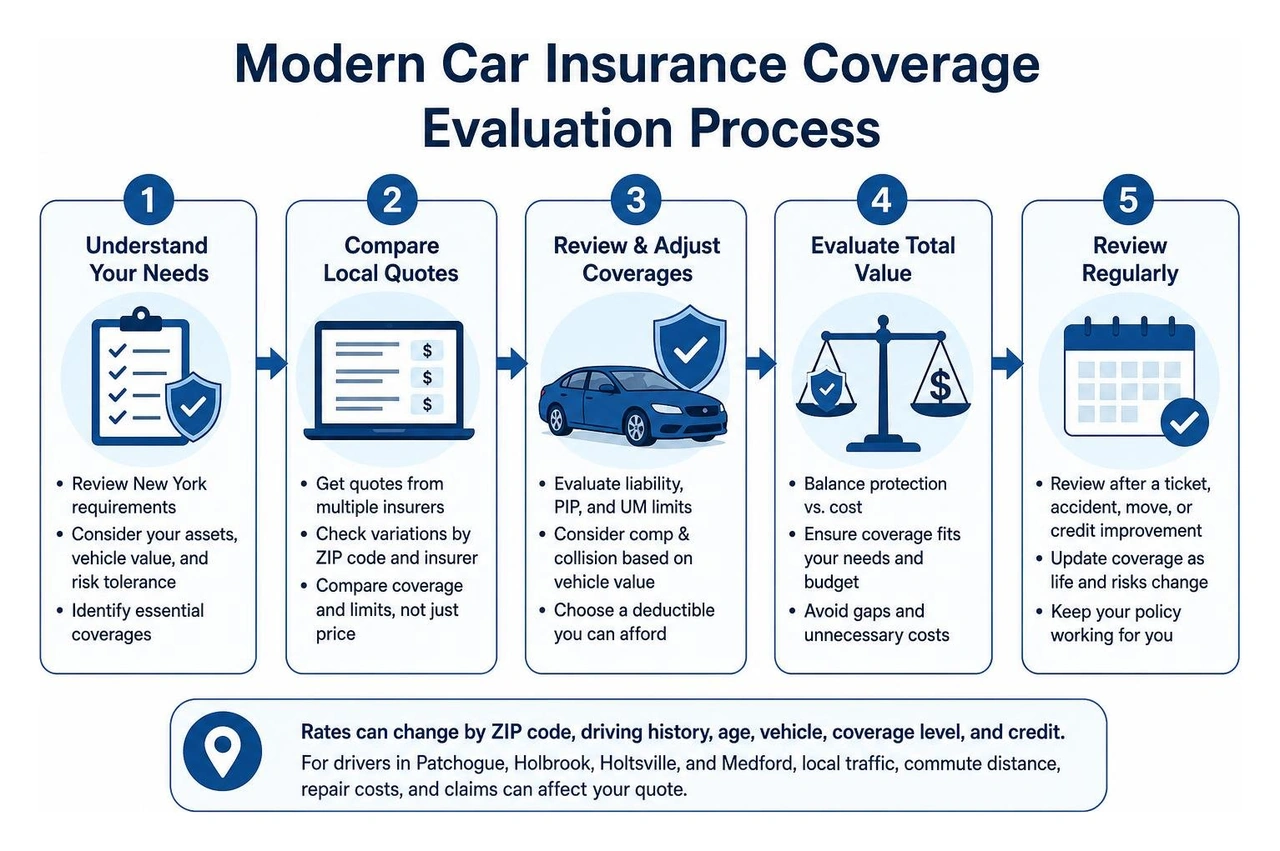
The fastest way to find the Cheapest Car Insurance NY drivers can get is to compare several quotes for the same coverage, then apply every discount you qualify for. Start with these steps:
- Compare local and statewide insurers, not just one renewal offer.
- Take a New York-approved defensive driving course.
- Ask about bundling, low-mileage, good-student, and vehicle-safety discounts.
- Choose a deductible you can afford if you need to file a claim.
- Review your policy after a ticket, accident, move, or credit improvement.
Rates can change sharply by ZIP code, driving history, age, vehicle, coverage level, and credit-based insurance factors. That matters for drivers in Patchogue, Holbrook, Holtsville, and Medford, where Long Island traffic, commute distance, repair costs, and local claims can all affect a quote. Comparing coverage carefully is just as important in Patchogue, Holbrook, Holtsville, and Medford as it is across Long Island.
New York also requires no-fault coverage, including personal injury protection, so the cheapest legal policy is not always the best fit. Drivers in Patchogue, Holbrook, Holtsville, and Medford should compare both price and protection before choosing a policy. A smart review can help Long Island households avoid paying for gaps they do not need while keeping meaningful coverage for the risks they do face on Long Island.
I'm Rick Braile, and the next steps explain how Long Island drivers can compare policies and lower costs without cutting essential protection.

1. Meet State Minimums Strategically Without Sacrificing Essential Protection
Every motorist navigating the Empire State must carry a baseline level of auto coverage mandated by the New York State Department of Financial Services. Specifically, the law requires bodily injury liability limits of $25,000 per person and $50,000 per accident, along with $10,000 in property damage liability (the classic 25/50/10 rule). Because New York operates under a no-fault system, your policy must also include $50,000 in Personal Injury Protection (PIP) to cover medical bills and lost wages regardless of who caused a collision, plus mandatory Uninsured Motorist bodily injury protection.
While satisfying minimum statutory requirements offers the lowest upfront price, relying solely on state minimums can leave your personal savings exposed. When an accident occurs on major arteries across New York, a $10,000 property damage cap can easily be exhausted by modern vehicle repair expenses. Exploring comprehensive and collision options through Full Coverage Car Insurance shields you from bearing major crash damage out of pocket. Recent data highlighted in an Experian 2026 New York rate study confirms that while minimum liability keeps entry costs manageable, upgrading your liability cushions provides vastly superior financial security per dollar spent.
Evaluating Minimum Liability vs. Comprehensive and Collision
Deciding whether to carry physical damage coverage depends primarily on your car's market value, your loan status, and your tolerance for financial risk. If you drive a newer vehicle or lease through a financial institution, collision and comprehensive safeguards are mandatory terms of your agreement. Collision handles damage sustained when your car strikes another vehicle, a guardrail, or an icy obstruction. Comprehensive protects against non-collision hazards common across New York, including fallen tree limbs, coastal flooding, deer strikes, and vehicle theft.
For older, fully paid-off vehicles that have experienced substantial vehicle depreciation, we often recommend applying the practical 10% rule: if the annual cost of comprehensive and collision coverage exceeds 10% of your vehicle's fair market value, dropping down to standard liability limits can be a sensible money-saving maneuver.
2. Compare Local Quotes Across New York and Long Island
Location is one of the primary variables insurers evaluate when determining your premium tier. Actuaries calculate pricing based on territory-level risk, meaning collision frequency, litigation rates, vandalism statistics, and local repair labor costs influence your final quote. That is why drivers comparing rates across Suffolk County often see distinct pricing shifts between adjacent communities.

Whether you commute along Sunrise Highway through Patchogue, travel local routes near Holbrook, head north into Holtsville, or manage everyday errands around Medford, localized risk profiles shape baseline numbers. Looking at Auto Insurance Long Island Compare resources helps highlight how neighborhood claim statistics influence regional premiums. Local motorists can also reference dedicated guides like the Car Insurance Medford NY Guide to understand community-level policy considerations across Long Island.
Navigating Downstate Congestion vs. Upstate Regional Pricing
The cost disparity between different regions of New York is dramatic. Dense downstate territories, particularly New York City boroughs like Brooklyn and Queens, feature elevated claim frequencies due to heavy pedestrian traffic, intense street parking density, and higher rates of vehicle theft.
By contrast, suburban Long Island corridors enjoy lower claim densities than urban centers, while rural upstate regions experience even lower traffic congestion. However, Long Island motorists still encounter winter weather challenges, icy coastal roadways, and heavy parkway traffic during peak commuting hours. Reviewing quotes from several regional carriers ensures you do not overpay for suburban risk factors.
3. Maximize Defensive Driving and Statutory Policy Discounts
One of the most dependable ways to lower your premiums is taking advantage of New York statutory discounts. Under state law, completing a Department of Motor Vehicles-approved Point and Insurance Reduction Program (PIRP) course grants you a mandatory 10% reduction on your auto liability, no-fault, and collision base premiums for three full years. In addition to direct premium savings, a PIRP course can remove up to four violation points from your active driving record, helping you avoid costly driver responsibility surcharges.
Furthermore, New York State mandates that all auto insurers offer statutory safety equipment discounts. If your vehicle is equipped with factory-installed anti-lock brakes (ABS), automatic daytime running lamps, or passive restraints like dual airbags, you are legally entitled to rate reductions on applicable coverage portions. You can read more about maximizing these credits through our overview of Good Driver Discounts NY.
Bundling Multi-Policy Lines and Safety Feature Credits
Beyond state-mandated credits, insurance carriers offer generous merit-based and lifestyle discounts. One of the most effective strategies is combining multiple insurance policies under a single umbrella. Pairing your vehicle policy with homeowners, condo, or renters coverage frequently triggers multi-policy discounts ranging from 10% to 25%.
- Multi-Vehicle Policies: Insuring two or more family vehicles on the same policy to secure fleet discounts.
- Paperless & Autopay Enrollments: Securing administrative fee waivers and recurring bill credits.
- Anti-Theft Device Installations: Applying credits for GPS tracking, ignition immobilizers, or audible alarms.
- Telematics Participation: Using mobile driving monitors to log safe speeds and low late-night road hours.
4. How to Qualify for the Cheapest Car Insurance NY Rates by Driver Profile
Underwriting formulas evaluate personal demographic and behavioral variables to place applicants into specific rating tiers. Insurers analyze your driving history, vehicle model, annual mileage, and credit-based insurance score. Maintaining clean credit is critical in New York; drivers with excellent credit scores frequently secure rates significantly lower than those with challenged credit histories facing high-risk underwriting tiers. You can explore broader market pricing insights in statewide auto insurance trends and discover how local drivers keep costs predictable with Cheap Car Insurance Long Island.

Strategies for Seniors and Young Drivers to Get the Cheapest Car Insurance NY Policies
Young drivers and senior operators represent two distinct demographic categories that often encounter higher baseline rates. For teens and college students, high rates stem from statistical accident frequencies linked to inexperience behind the wheel. To mitigate these costs, families can add young drivers to an existing parent policy rather than setting up standalone coverage, while capitalizing on Car Insurance Student Discount NY options for maintaining a 3.0 ("B") GPA or higher.
Mature drivers across New York can reduce their insurance overhead by enrolling in senior-specific driver safety refreshers and adjusting their annual mileage thresholds. As retirement reduces daily rush-hour commutes, informing your carrier of reduced yearly miles often unlocks valuable low-mileage discount tiers.
Securing the Cheapest Car Insurance NY Coverage After Violations or Credit Issues
A moving violation, speeding ticket, or at-fault accident can lead to premium surcharges upon policy renewal. In New York, accumulating six or more points on your driving record within an 18-month window triggers a mandatory DMV Driver Responsibility Assessment (DRA) fee, which adds hundreds of dollars in state surcharges over three years on top of insurance increases.
If a severe infraction or credit setback causes standard carriers to decline coverage, New York drivers can access essential protection through the New York Automobile Insurance Plan (NYAIP). While the assigned risk pool acts as a vital safety net, practicing consistent safe driving and rebuilding your credit score allows you to transition back to preferred commercial market rates within a few policy cycles.
5. Adjust Deductibles, Vehicle Choice, and Mileage Annually
Fine-tuning your policy structure on an annual basis ensures your coverage mirrors your real-world driving habits. One of the simplest ways to lower your ongoing premium is calibrating your physical damage deductibles. Increasing your collision and comprehensive deductible from $500 to $1,000 can deliver immediate premium reductions, provided you maintain sufficient emergency savings to cover the higher out-of-pocket amount if a claim occurs.
Vehicle selection also plays a massive role in ongoing insurance expenses. Vehicles with high safety ratings, low theft rates, and accessible replacement parts are significantly cheaper to insure than high-performance sports cars or luxury imports with specialized sensor assemblies.
Finally, if you work remotely or commute via public transit, enrolling in Usage Based Insurance Save Money programs allows your insurer to track your low annual mileage and reward your reduced road exposure with substantial discounts.
Frequently Asked Questions About New York Auto Insurance
What is the state minimum car insurance requirement in New York?
New York law requires all drivers to carry a minimum of 25/50/10 liability protection: $25,000 bodily injury liability per person, $50,000 bodily injury liability per accident, and $10,000 property damage liability. Additionally, policies must include $50,000 in Personal Injury Protection (PIP) and matching statutory Uninsured Motorist coverage.
How much can a defensive driving course save on New York premiums?
Voluntarily completing a New York DMV-approved Point and Insurance Reduction Program (PIRP) course provides a guaranteed 10% discount on auto liability, collision, and no-fault base premiums for three full years. It also allows you to subtract up to four active points from your driving record.
Why are auto insurance rates significantly higher on Long Island and NYC?
Premiums are higher downstate due to elevated traffic volume, higher population density, increased frequency of litigation, severe weather risks, and higher local auto repair labor costs compared to rural upstate territories.
Conclusion
Finding affordable vehicle protection across New York does not mean you have to settle for weak coverage or sacrifice peace of mind. By taking advantage of statutory defensive driving discounts, bundling your home and auto policies, calibrating physical damage deductibles, and conducting annual policy checkups, you can secure dependable protection tailored to your household budget.
As an independent, client-centered agency rooted right here in the Patchogue community, we at Bay Harbour Insurance Agency are proud to serve our neighbors throughout Holbrook, Holtsville, Medford, and all across Long Island. Because we work independently, we evaluate multiple top-rated regional carriers on your behalf to find the ideal balance of pricing, coverage limits, and exceptional claims service.
Whether you are insuring a new vehicle or reviewing an existing policy in Patchogue, Holbrook, Holtsville, or Medford, our team is here to guide you every step of the way. Connect with us today to explore personalized auto insurance options built for Long Island drivers.