

Why E&O Liability Insurance Matters for Your Long Island Business
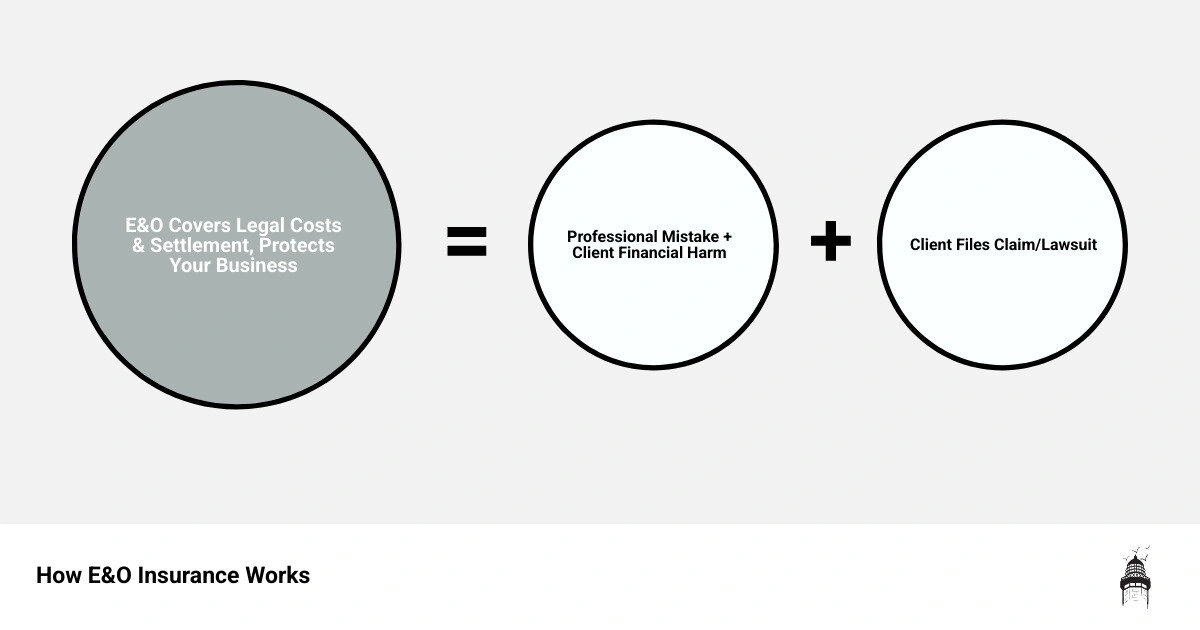
E&O liability insurance (Errors and Omissions) is a crucial form of professional liability coverage. It protects your Long Island business when a client claims your professional services caused them financial harm. For any professional in Holbrook, a real estate agent in Patchogue, or an IT expert in Medford, this policy is essential. It covers legal defense costs, settlements, and judgments when you're accused of a professional mistake, negligence, a missed deadline, or providing inaccurate advice.
Even the most diligent professionals can make an error. A single oversight can lead to a lawsuit costing tens of thousands to defend—even if you're innocent. For service-based businesses across Long Island, from Holtsville to Medford, E&O insurance provides vital financial protection and peace of mind. Without it, your personal assets are on the line. One claim could drain your savings and ruin your reputation, which is why many clients and New York licensing boards now require proof of E&O insurance.
This guide explains what E&O liability insurance covers, who needs it, its cost in New York, and how to choose the right policy for your business in places like Patchogue or Holbrook.
What Is E&O Insurance and How Is It Different?
Many business owners on Long Island find the variety of insurance policies confusing. Let's clarify E&O liability insurance, also known as professional liability insurance. It protects you when a client claims your professional advice or service caused them financial loss. It's designed for businesses that sell expertise. If someone alleges you made a mistake, gave bad advice, or failed to deliver, this policy covers your legal defense and any resulting settlement.
E&O focuses on financial harm, not physical injury. A consultant in Patchogue whose advice costs a client money needs E&O. An accountant in Holbrook who misses a tax deadline needs it. A real estate agent in Holtsville who fails to disclose a property defect also needs E&O insurance. Even if a claim is baseless, defending your Medford business in court is expensive. E&O liability insurance covers those legal bills, offering protection that a general liability policy does not. To learn more about comprehensive business protection, check out our guide on Business Owner Protection.
E&O vs. General Liability Insurance
Think of these policies as protecting different aspects of your business. General liability covers physical risks (bodily injury, property damage), while E&O liability insurance covers professional risks (work errors, bad advice).
For example, if a client slips in your Holtsville office, that's a general liability claim. But if your marketing advice for that client leads to a failed product launch, that's an E&O claim. An IT consultant in Medford who recommends faulty software causing data loss would need E&O, not general liability. Most businesses on Long Island need both policies for complete protection. For more details, visit our General Liability Insurance NY page.
What E&O Insurance Covers—And What It Doesn't
Understanding what your E&O liability insurance covers is essential for any service-based business in Holbrook, Medford, or anywhere on Long Island. This coverage is your safety net when clients claim your professional work caused them financial harm.
E&O insurance is comprehensive, covering a wide range of professional risks. This includes:
- Professional mistakes and negligence: It protects you from claims of human error, miscalculations, or failing to meet industry standards.
- Errors and omissions: The policy covers situations where you missed a critical detail or forgot to include something important. A real estate agent in Patchogue might face a claim for not disclosing a property issue, or an IT consultant in Holtsville could be sued for omitting a key security feature.
- Inaccurate advice and misrepresentation: If your professional guidance leads a client to a financial loss, E&O covers the resulting legal costs. This applies even to unintentional errors in your communications.
- Violation of good faith and fair dealing: It defends you against claims that you didn't uphold your ethical or contractual obligations.
Trust is the foundation of professional relationships in New York. When something goes wrong—or a client in Medford believes it did—you need protection that understands the unique risks of providing services.
Common E&O Policy Exclusions
While E&O liability insurance is vital, it doesn't cover everything. Understanding these exclusions helps your Patchogue business build a complete insurance portfolio. Key exclusions include:
- Intentional wrongdoing and fraud: E&O covers honest mistakes, not deliberate or criminal acts.
- Bodily injury and property damage: These are covered by general liability insurance. If a client is injured in your Holbrook office, that's a general liability claim.
- Employee injuries: This falls under Workers' Compensation insurance.
- Employment disputes: Wrongful termination or harassment claims require Employment Practices Liability Insurance (EPLI).
- Prior acts without continuous coverage: Gaps in your E&O coverage can leave past work uninsured.
- Simple breach of contract: The policy typically covers breaches tied to a professional error, not a simple failure to complete work.
Understanding these gaps is crucial for protecting your business in Holtsville or anywhere on Long Island. For more insights, see our Errors & Omissions Insurance Basics.
Understanding Your E&O Liability Insurance Policy
Insurance policies can be dense, but with E&O liability insurance, understanding the details is critical. Unlike other insurance types, there is no "standard" E&O policy. Terms, conditions, and exclusions vary dramatically between insurers.
Skimming the fine print could leave your Medford company vulnerable. At Bay Harbour Insurance Agency, we help Long Island professionals decode their policies. We'll walk you through the document, explaining what each section means for your Holbrook business in plain English.
Claims-Made vs. Occurrence Policies
The most important concept to grasp is the difference between claims-made and occurrence policies, as it determines how your coverage responds.
Most E&O policies are claims-made. This means the policy covers claims made during the policy period, as long as the work happened after your policy's retroactive date. The timing of the claim is what matters. For example, a consultant in Patchogue gives advice in 2022. The client sues in 2025. A claims-made policy active in 2025 would provide coverage. If the policy lapsed in 2024, there would be no coverage.
Occurrence policies cover incidents that happened during the policy period, regardless of when the claim is filed. These are extremely rare for E&O because professional errors can surface years later.
Your retroactive date is crucial for claims-made policies, marking how far back your work is covered. When you first buy E&O, this is the policy start date. If you switch carriers carelessly, you could move this date forward, creating a coverage gap for past work.
Tail coverage (or an extended reporting period) is a safety net if you retire, sell your business, or switch carriers. It extends the window to report claims for work done before your policy ended. This is vital for professionals in Holtsville and across Long Island, as professional mistakes have a "long tail" and can surface years later. Maintaining continuous coverage is critical. If you're considering a change, talk to us first. We'll help you steer the transition without leaving your New York business vulnerable. Learn more in our guide on how to Secure Your Business with Professional Liability Insurance.
Who Needs E&O and How Much Does It Cost?

If you provide professional advice or services for a fee, you need E&O liability insurance. Whether you're a solo consultant in Holtsville or a growing agency in Patchogue, you're exposed to claims of financial harm.
Many clients on Long Island now require proof of E&O coverage before signing a contract. It's a standard part of the vetting process. Certain licensed professions in New York also have E&O requirements. Without coverage, a single lawsuit can be devastating. Legal defense alone can cost thousands, and a judgment could bankrupt your Medford business and put your personal assets at risk.
Professions That Need E&O Coverage
While nearly any service business benefits from E&O liability insurance, some face higher exposure:
- Consultants: Your advice is your product, making you a prime target for claims if that advice leads to financial loss.
- Accountants and Bookkeepers: Errors in financial data or tax filings can lead to costly lawsuits.
- Real estate agents: Professionals in Patchogue and across Long Island face claims for issues like failure to disclose property defects or errors in paperwork.
- IT Professionals and Web Developers: A software bug, data breach, or failed website launch can trigger immediate claims.
- Architects and Engineers: Design flaws can result in construction delays and expensive, long-term lawsuits.
- Insurance Agents: Failing to secure the right policy for a client can make you liable for their uncovered losses.
Key Factors Influencing E&O Insurance Costs
E&O premiums for your Holbrook business are based on your unique risk profile. Key factors include:
- Industry and Risk Level: High-risk professions (e.g., architects) pay more than lower-risk ones (e.g., graphic designers).
- Business Size and Revenue: Larger businesses with more client interactions have greater exposure and higher premiums.
- Location: Operating in New York's active legal market can influence rates.
- Claims History: Past claims will increase your premium.
- Coverage Limits and Deductibles: Higher limits increase the cost, while a higher deductible lowers it.
Nationally, small businesses pay an average of around $735 per year. Some low-risk businesses can find coverage for as little as $19 per month. Your actual cost will depend on these factors. For more context, see Errors and Omissions Insurance: What It Is, How It Works, and Who Needs It. To get an accurate price for your business, request a Business Insurance Quote Long Island.
Choosing the Right Policy and Filing a Claim
Choosing E&O liability insurance is a critical decision for business owners in Medford, Holbrook, and Patchogue. The right policy is a financial shield; the wrong one leaves dangerous gaps. We help you choose protection that works for your specific situation and ensure you know what to do if you need to use it.
How to Select the Right E&O Policy
Follow these steps to build a custom safety net for your Long Island business:
- Assess Your Risks: Consider what could go wrong in your specific line of work. A real estate agent in Patchogue faces different risks than an IT consultant in Holtsville.
- Determine Coverage Limits: Choose per-claim and aggregate limits that reflect your worst-case scenario, not just what seems affordable.
- Select Your Deductible: Find the right balance between a lower premium (higher deductible) and what you can afford to pay out-of-pocket when a claim hits.
- Review Policy Exclusions: We'll help you go through the fine print to understand what your policy won't cover and address any potential gaps.
- Work with an Independent Agent: As an independent agency in New York, we compare policies from multiple insurers to find the best fit for your needs.
- Conduct Regular Reviews: Your coverage should evolve with your business. Our Reasons for SME Owner Insurance Review page explains why this is vital.
Steps to Take When Filing an E&O Liability Insurance Claim
Your response in the first few hours after an incident is critical.
- Notify Your Insurer Immediately: Call us the moment you learn of a potential claim. With claims-made policies, timing is everything. Delaying could jeopardize your coverage.
- Document Everything: Gather all contracts, emails, notes, and records related to the project and the alleged error.
- Cooperate Fully: Your insurer will assign an adjuster and legal counsel. Provide all requested information promptly and honestly.
- Avoid Admitting Fault: Do not apologize or discuss liability with the client. Let your legal team handle all communications about fault or settlements.
The claims process on Long Island can take time. Your E&O liability insurance provides not just money for a settlement, but the expert legal support needed to steer a complex situation in Medford or Holbrook.
Frequently Asked Questions about E&O Liability Insurance
We hear these questions often from business owners across Long Island. Here are clear answers to common concerns about E&O liability insurance.
Is E&O insurance legally required in New York?
For most businesses, no state law mandates E&O liability insurance. However, it's often a practical necessity. Certain licensed professions, like real estate brokers, may be required to carry it. More importantly, client contracts for businesses in Holbrook, Patchogue, and across New York frequently make E&O a non-negotiable requirement. Even if not legally required, it's a smart business decision that protects your assets and demonstrates professionalism.
Can I get E&O insurance for past work?
Yes, through a feature called prior acts coverage. Your policy's retroactive date determines how far back in time your work is covered. As long as you maintain continuous E&O liability insurance, your current policy will likely cover all work done since your original retroactive date. Letting your policy lapse, even for a short time, can create a permanent coverage gap for past work, a major risk for any professional in Medford or Holtsville. When switching carriers, always ensure your retroactive date is maintained.
What is the difference between E&O and Professional Liability Insurance?
They are essentially the same thing. The terms are often used interchangeably, with the preferred name varying by industry. Real estate and IT professionals on Long Island often say "E&O insurance," while accountants and consultants in places like Holtsville or Medford might use "Professional Liability Insurance." Both refer to the same core protection: coverage for financial loss claims arising from your professional services in New York.
Conclusion

The key takeaway is that E&O liability insurance is not optional for service professionals—it's essential. It is your financial safety net when a client claims your work caused them harm. Without it, a single lawsuit could destroy the business you've worked so hard to build in Patchogue, Holbrook, or anywhere on Long Island.
We've covered what E&O protects, how it differs from other policies, and why professionals from Holtsville to Medford need this coverage. Your expertise is your most valuable asset, and it must be protected. Even the most careful New York professionals can face claims, and the cost of defense alone can be crippling.
Having the right E&O liability insurance policy allows you to serve clients with confidence, knowing you're prepared. At Bay Harbour Insurance Agency, we understand the challenges facing businesses in New York. We listen to your needs to find the right protection for your practice.
Don't wait for a claim to arrive. Get expert guidance from a business insurance agency in Patchogue, NY today, and let's secure the comprehensive protection your business deserves.