
How to Lower the Cost of Car Insurance for Teens
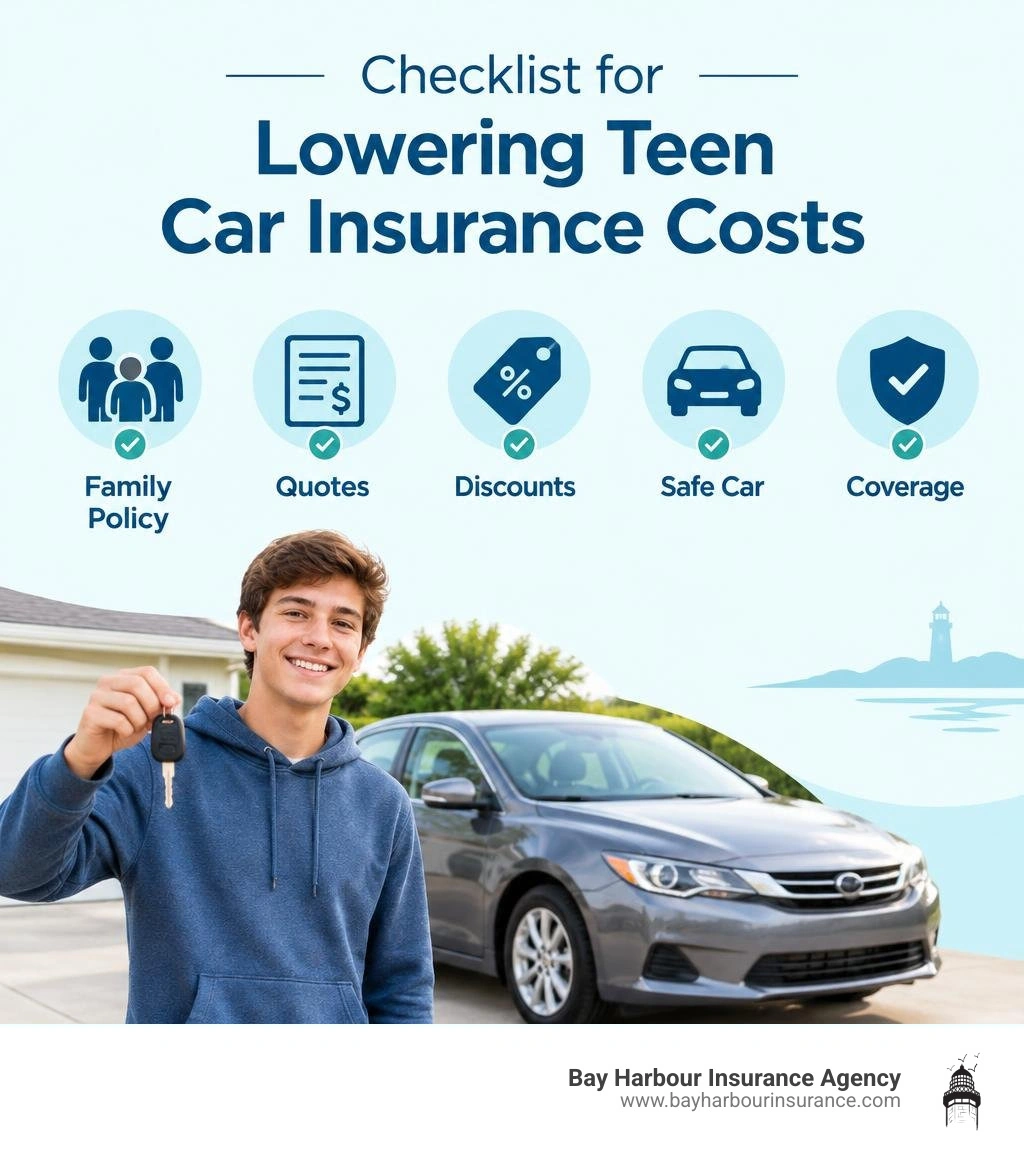
To find car insurance for teens that fits your budget, start by asking what it would cost to add your teen to a parent’s policy. Then compare quotes, ask about good student and driver training discounts, and choose a safe car that is affordable to insure. Keep enough liability coverage to protect your family, even if a lower limit looks cheaper.
For families in Patchogue, Holbrook, Holtsville, Medford, and across Long Island, the best approach is to compare the total cost and coverage before your teen starts driving. I’m Rick Braile, and I’ll walk you through the steps.
Car insurance for teens terms you need:
Understanding the True Cost: Why Premiums Spike for Young Drivers
Handing over the car keys to a newly licensed teenager is a major milestone, but opening the first insurance statement afterward can quickly dampen the celebration. When an inexperienced driver gets behind the wheel, auto insurance carriers view the risk through a purely statistical lens. In experienced driving hands, everyday commutes along Route 112 in Medford or Sunrise Highway near Patchogue are second nature; for a novice driver, busy suburban thoroughfares present a dense environment of sudden stops, merging traffic, and high-speed intersections.
Actuarial data consistently shows why rates rise. According to the Insurance Institute for Highway Safety, teenage drivers experience crash rates per mile driven that are nearly four times higher than drivers aged 20 and older. While drivers aged 20 and younger represent only about 5.1 percent of licensed drivers in the United States, they account for roughly 12 percent of all motor vehicle crashes and nearly 9 percent of fatal collisions. Furthermore, national youth risk behavior surveys indicate that 39 percent of high school students admit to texting or emailing while behind the wheel, compounding distraction risks in heavy commuter traffic across Long Island.
To offset this heightened probability of severe claims, insurance companies price young drivers into elevated risk tiers. These pricing models also reflect differences between demographics. Nationally and across New York, newly licensed male teenagers face statistically higher fatal accident and moving violation rates than female teenagers, leading carriers to price male teen policies higher on average.
The benchmark findings published in the MoneyGeek 2026 teen car insurance pricing report demonstrate how household structure and age interact:
Understanding these baseline figures helps parents prepare for the road ahead while seeking effective ways to manage expenses.
Factors That Drive Up Car Insurance for Teens
Beyond age-based demographics, specific behavioral and situational triggers can dramatically inflate insurance costs. Novice drivers lack the muscle memory and hazard-anticipation skills that older motorists develop over decades. When combined with peer passengers, night driving, or unfavorable weather along the Long Island Expressway near Holbrook and Holtsville, the likelihood of an incident rises.
Specific factors that trigger steep premium surcharges include:
- At-Fault Collisions: A single at-fault collision on a young driver's record creates an immediate spike in annual premiums that typically follows the household for three to five policy years.
- Major Moving Violations: Speeding tickets, reckless driving citations, and failure-to-yield infractions demonstrate aggressive or careless driving, causing insurers to reclassify the driver into a non-standard risk tier.
- Strict Substance Violations: Driving under the influence (DUI) carries severe financial and legal penalties. A DUI violation can increase baseline insurance costs by over 50 percent, in addition to license suspension.
- Graduated Driver Licensing (GDL) Infractions: Violating junior license restrictions, such as carrying unauthorized non-family passengers or driving past designated curfews without a parent present, creates immediate compliance issues with both the state and the insurer.
When Does Car Insurance for Teens Become Cheaper?
The steep pricing associated with young drivers does not last forever. Auto insurers continually re-evaluate risk profiles as young motorists gain verifiable road experience without incident.
Rates begin to ease at well-defined age milestones:
- Age 19: After three continuous years of licensed driving without citations, drivers typically see their first major policy reduction of roughly 16 percent.
- Age 21: Reaching adulthood brings another average rate reduction of 17 percent, reflecting greater maturity and stable driving routines.
- Age 25: Motorists age out of the young driver risk pool entirely, seeing an additional 11 percent price drop that brings premiums down to standard adult baseline tiers.
The single most effective catalyst for lowering your monthly costs across every milestone is maintaining an unblemished record and utilizing good driver discounts in NY.
How to Structure Car Insurance for Teens: Family Plan vs. Separate Policy

One of the most consequential decisions parents face is deciding how to legally structure their teenager's coverage. When a teen gets their junior license, families generally choose between adding them as a named operator on an existing family policy or purchasing a standalone, individual policy for the young driver.
To secure cheapest car insurance on Long Island, combining coverage under a single household plan is almost always the better choice. Insurance carriers price family policies through household risk pooling. This means the seasoned driving records, continuous insurance history, and established credit profiles of the parents help balance out the statistical risk of the novice driver.
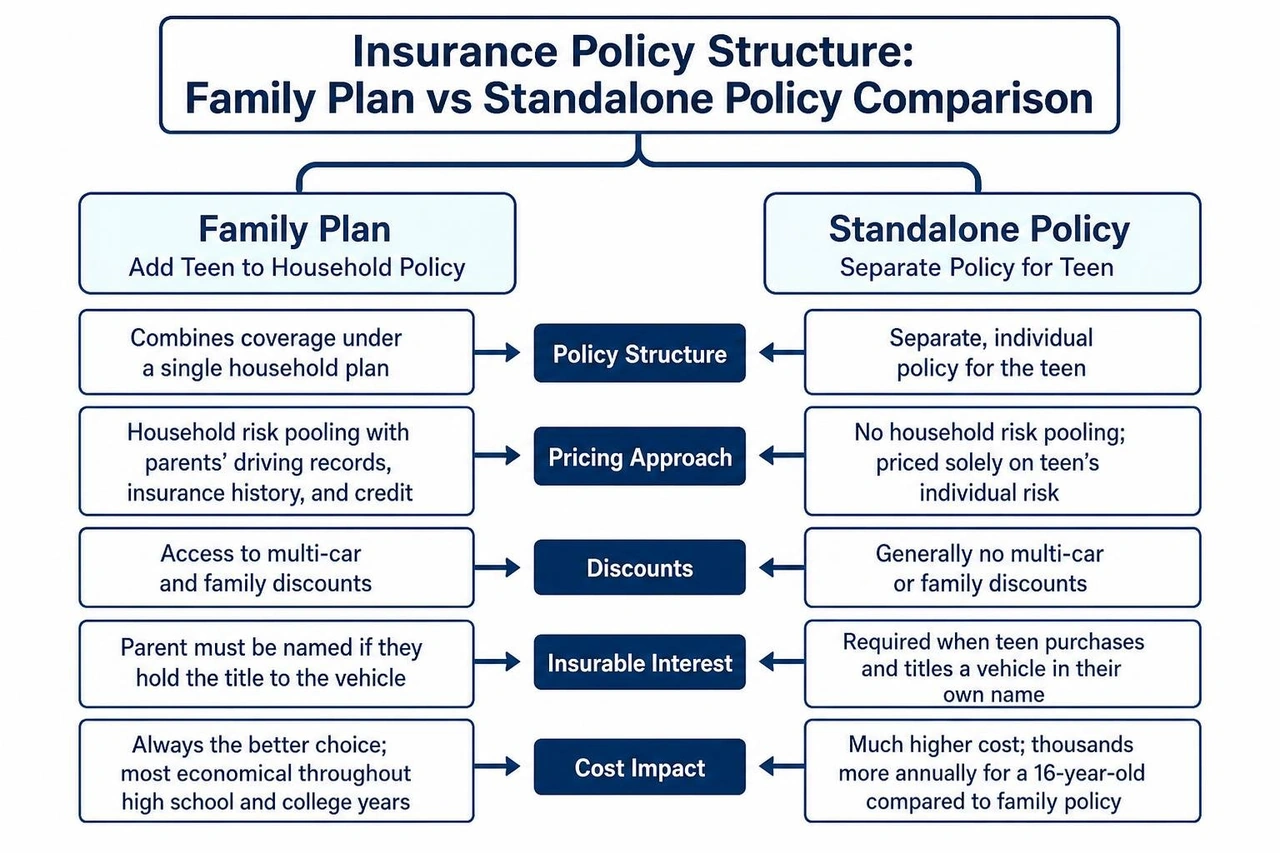
Furthermore, the legal principle of insurable interest plays a crucial role. If a parent holds the title to the vehicle, the parent must be named on the insurance policy. If a teenager purchases and titles a vehicle entirely in their own name, many carriers will require a separate policy, eliminating the advantages of multi-car and family discounts.
Adding a Teen to a Household Policy vs. Buying a Standalone Policy
The financial difference between a family plan and an individual policy is substantial. A 16-year-old driver listed on a family policy saves thousands of dollars annually compared to purchasing a separate standalone policy. This price gap shrinks as drivers reach age 18 or 19, but keeping young adults on the household policy remains the most economical strategy throughout their high school and college years.
In addition to base rate savings, family policies offer several structural discounts:
- Multi-Car Discounts: Insuring multiple vehicles under the same policy lowers the baseline rate on every automobile in the driveway.
- Multi-Policy Bundling: Pairing personal auto policies with homeowners or umbrella insurance softens the overall premium impact of adding a young driver.
- Driver Assignment Optimization: On multi-car family policies, an experienced independent agent can strategically assign the teenager as the primary driver on the safest, lowest-value family vehicle while keeping parents assigned to newer or higher-performance cars.
Risks of Driver Exclusion and Leaving Teens Uninsured
When facing an unexpected rate increase, some parents might consider leaving their licensed teen off the policy or signing a "named driver exclusion." In states where driver exclusions are permitted, this endorsement explicitly states that the excluded individual will never operate the insured vehicle.
However, taking this approach creates massive financial and legal risks:
- Total Claim Denials: If an unlisted or excluded teenager operates the family car—even just backing it out of a driveway or making a quick trip to a local store in Medford or Patchogue—and causes an accident, the insurance carrier can completely deny collision and liability coverage.
- Personal Financial Exposure: Without liability coverage, parents are personally liable for medical bills, vehicle damage, and legal judgments resulting from a crash, putting savings, investments, and home equity at risk.
- License Suspensions and State Penalties: Operating an uninsured motor vehicle violates state law, leading to mandatory license suspensions, substantial fines, and placement into high-risk assigned auto plans.
Every licensed member of the household must be properly disclosed to your insurance agent to preserve valid, enforceable protection.
Step-by-Step Guide to Lowering Teen Driver Premiums

Managing the cost of insuring a teen driver requires a proactive approach. Rather than accepting the initial rate increase at face value, families can leverage structured discounts, academic incentives, and vehicle choices. Practical consumer advice and recent Consumer Reports teen auto insurance findings emphasize that layered discounts can lower the net cost of adding a young driver by hundreds of dollars per year.
Families looking for reliable savings can follow these practical steps:
- Contact an independent insurance agent before your teen finishes driver education to model policy options.
- Submit official school transcripts to establish academic eligibility for discounts.
- Enroll the teen in state-approved defensive driving or advanced driver training programs.
- Download and activate carrier-approved telematics or mobile tracking applications to verify safe road habits.
- Review physical damage deductibles to balance monthly premiums with out-of-pocket comfort levels.
Maximizing Student and Driver Training Discounts
Academic achievement directly correlates with lower road risk in the eyes of insurance actuaries. Carriers reward high-achieving high school and college students because responsible study habits often translate into focused, responsible behavior behind the wheel.
Key discount programs to explore include:
- Good Student Discounts: Full-time high school or college students who maintain a cumulative "B" average (3.0 GPA), make the Dean's List, or earn Honor Roll recognition can qualify for significant discounts of 8 to 16 percent. Submitting updated transcripts each semester keeps the car insurance student discount in NY active.
- Driver Training Programs: Completing an accredited high school driver education program or a state-certified defensive driving course sharpens hazard awareness and earns a 5 to 10 percent credit on liability and collision coverage.
- Student-Away-at-School Discounts: If your college-aged driver attends school more than 100 miles away from home without a vehicle, they remain covered as an occasional driver when visiting home for breaks while receiving a substantial rate reduction throughout the academic year.
Utilizing Telematics and Adjusting Policy Deductibles
Technology-driven policies provide an additional way for safe young drivers to demonstrate their skills and earn immediate savings. Opting into usage based insurance to save money allows carriers to monitor actual driving behavior via an onboard plug-in device or smartphone mobile app.
These telematics programs measure specific safety metrics:
- Smooth acceleration and gradual braking
- Adherence to posted speed limits
- Nighttime driving frequency (minimizing driving between midnight and 4:00 AM)
- Total annual mileage driven
- Zero active smartphone interaction while the vehicle is in motion
In addition to telematics, adjusting comprehensive and collision deductibles helps control annual costs. Raising physical damage deductibles from $500 to $1,000 lowers recurring monthly premiums. Families should maintain enough liquid emergency savings to comfortably cover the higher deductible in the event of a covered claim.
Selecting the Best Vehicles and Adequate Coverage Limits
The vehicle your teen drives plays a major role in calculating insurance costs. Many parents assume purchasing an inexpensive, heavily used car is the most cost-effective solution. However, older vehicles often lack modern crash-avoidance technology, structural safety enhancements, and modern airbags, which can drive up personal injury and liability costs.
Conversely, gifting a newly licensed driver a high-performance sports car, a modified vehicle, or a heavy luxury SUV introduces significant risk. High-horsepower engines increase the temptation to speed, while complex electronic components in luxury vehicles make body repairs expensive.
Vehicle Selection: Safety Ratings vs. High-Performance Models
When shopping for a vehicle, prioritize balanced, reliable mid-size sedans, compact crossovers, or small wagons with top safety evaluations from organizations like the Insurance Institute for Highway Safety (IIHS).
Consider the following vehicle guidelines:
- Prioritize Top Crash Test Ratings: Vehicles built with high-strength safety cages and standard front, side, and curtain airbags provide vital occupant protection in a crash.
- Look for Active Safety Features: Look for models equipped with Electronic Stability Control (ESC), automatic emergency braking, forward collision warnings, and blind-spot monitoring.
- Avoid High-Horsepower and Modified Cars: Sports coupes and turbocharged hatchbacks encourage aggressive driving and carry elevated insurance rate tables.
- Evaluate Comprehensive and Collision Value: For older, fully paid-off vehicles with minimal cash value, determine whether carrying full physical damage coverage makes sense. If the annual premium for collision and comprehensive coverage approaches the actual market value of the car minus your deductible, switching to liability-only coverage may be a practical move.
Optimal Liability Limits and Asset Protection for Families
When a teen starts driving, cutting corners on liability limits can leave your family financially exposed. If a novice driver causes a multi-car collision on the Long Island Expressway, medical expenses and property damage can quickly exceed state minimum coverage.
Families in Holbrook, Holtsville, and surrounding Long Island communities should consider carrying robust liability limits:
- Bodily Injury Liability: At least $100,000 per person and $300,000 per accident (or $250,000/$500,000 for broader protection).
- Property Damage Liability: At least $100,000 to cover modern vehicle repair and structural replacement costs.
- Personal Injury Protection (PIP) and Uninsured Motorist Coverage: Comprehensive no-fault and uninsured motorist protection ensures your teen and passengers receive proper medical coverage regardless of who is at fault.
To protect household assets, savings, and future earnings, pairing your auto policy with an umbrella policy provides an extra layer of liability protection above your base auto insurance in New York State policy.
Frequently Asked Questions About Teen Car Insurance
What happens if I don't add my licensed teenager to my insurance policy?
Failing to report a newly licensed driver living in your household violates your auto insurance contract. Insurance applications require you to list all licensed residents. If an unlisted teenager is involved in an accident, the insurer can investigate the claim for material misrepresentation.
This can lead to:
- Complete denial of vehicle damage and third-party liability claims
- Retroactive premium billing back to the date the teen received their license
- Policy cancellation or non-renewal
- Personal financial responsibility for all injuries and property damage resulting from the crash
Always notify your insurance agent as soon as your teen passes their road test and receives their driver's license.
How much does car insurance decrease once a teen turns 19 or 21?
Car insurance premiums typically decrease by about 16 percent when a driver turns 19, provided they have maintained a clean driving record free of at-fault collisions and moving violations. At age 21, drivers often see an additional 17 percent reduction as they establish a multi-year history of responsible driving. Compounding these age-based reductions with good student, defensive driving, and telematics discounts helps bring insurance costs closer to standard adult rates.
Can college students stay on their parents' auto insurance if attending school out of town?
Yes, full-time college students can generally remain on their parents' household auto policy as long as their primary permanent address remains the family home. If your student attends a university more than 100 miles away and leaves the family vehicle at home, notify your insurance provider. Most carriers will apply a student-away-at-school discount, significantly lowering the premium while keeping the student fully covered when they drive family vehicles during semester breaks, holidays, and summer vacations.
Conclusion
Insuring a new driver is an important step for any family, but managing the cost does not have to be overwhelming. By understanding the factors that influence premium rates, choosing safe vehicles, maximizing academic and defensive driving discounts, and maintaining strong liability limits, you can protect both your teen and your family's financial future.
Proactively reviewing your coverage helps you capture rate reductions as your teen gains driving experience. At Bay Harbour Insurance Agency, we take a client-centered, personal approach to help families across Medford, Holbrook, Holtsville, Patchogue, and all of Long Island find the right balance of coverage and value. As an independent agency, we compare options across top insurance carriers to tailor a policy that fits your family's needs.
Contact our local team today to review your coverage, explore all eligible young-driver discounts, and request a personalized Long Island auto insurance quote.