

Mandatory Coverage and NY Car Insurance for First Time Buyers
Stepping into vehicle ownership is exciting, but navigating the Empire State's regulatory landscape requires a clear understanding of mandatory protections. When searching for auto insurance in New York State, you cannot simply pick an arbitrary policy off the shelf. State law strictly mandates that every driver carry baseline liability, personal injury protection, and uninsured motorist coverage before setting a single tire on public roads.
New York operates under a 25/50/10 liability rule. In an at-fault accident, your policy must provide at least:
- $25,000 for bodily injury per person
- $50,000 total bodily injury liability per accident involving two or more people
- $10,000 for property damage liability per accident
In addition, state law requires mandatory uninsured motorist bodily injury coverage matching those same bodily injury minimums ($25,000 per person and $50,000 per accident). This protects you if you are struck by a hit-and-run driver or an uninsured motorist.
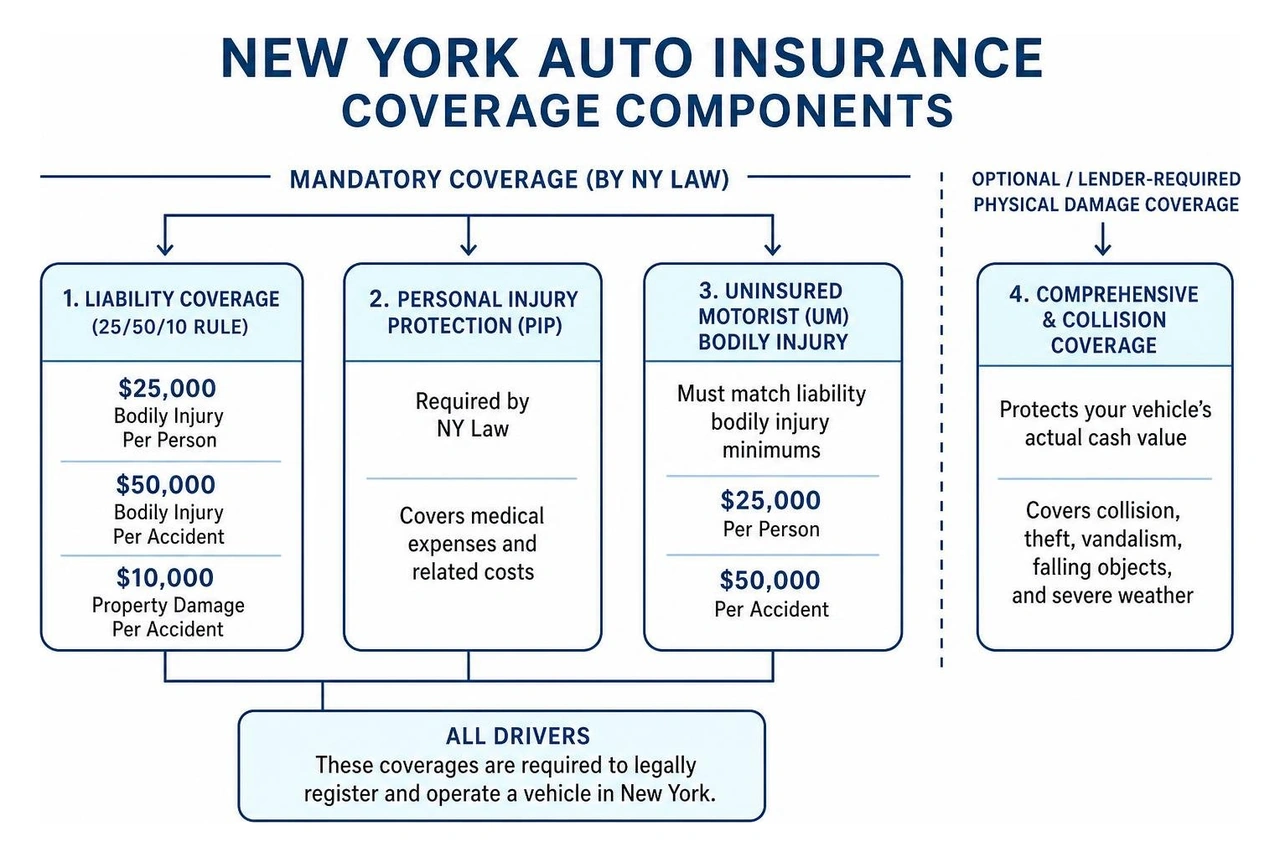
While these minimums let you register a vehicle legally, they leave severe financial gaps. If you lease or finance your vehicle, lenders will require you to carry physical damage coverage as well. Understanding the role of full coverage car insurance is critical here; comprehensive and collision coverages protect the actual cash value of your car against collisions, theft, vandalism, falling objects, and severe weather along our coastal communities.
State Minimums vs. Recommended Coverage Limits
The statutory property damage limit of $10,000 was established decades ago. Today, the average modern vehicle easily exceeds that figure in repair or replacement costs. If you cause a multi-car accident along Sunrise Highway or the Long Island Expressway during a busy Patchogue commute or through Holbrook traffic, $10,000 in property damage liability can be exhausted in seconds. Once your policy limit is reached, you become personally responsible for the remaining balance, putting your personal savings and future wages at direct risk.
For robust asset protection, financial professionals and independent agents generally recommend carrying higher limits, such as a 100/300/100 structure ($100,000 per person bodily injury, $300,000 per accident bodily injury, and $100,000 property damage liability).
Understanding Personal Injury Protection and DMV Tracking
New York is a no-fault insurance state. Regardless of who caused the collision, your own insurer covers your immediate medical treatment, rehabilitation expenses, and a portion of lost earnings through Personal Injury Protection (PIP). The basic statutory PIP limit provides up to $50,000 per person, including an allowance for lost wages (up to $2,000 per month for up to three years) and essential personal expenses.
Because coverage is mandatory, the New York Department of Motor Vehicles enforces continuous coverage through the Insurance Information and Enforcement System (IIES). Insurers electronically transmit policy updates, cancellations, and renewals directly to the DMV using designated three-digit insurance company codes. For an overview of how state regulations impact new drivers, review the details from New York Auto Insurance Rates & Requirements for New Drivers | New Driver Auto Facts. If coverage lapses for even a single day, the DMV initiates automatic compliance tracking, which can lead to registration suspension and civil penalties.
Key Cost Drivers and Average Rates for First-Time Drivers
When insurance carriers evaluate a first-time applicant, their primary pricing challenge is the absence of a proven driving record. Underwriting models rely on historical data to predict loss frequency and severity. Without prior insurance history or years behind the wheel, first-time drivers represent an unknown risk profile, placing them into higher pricing tiers.
Geography plays an equally decisive role. Congested urban centers with dense traffic patterns and elevated collision frequencies face higher risk assessments. By contrast, suburban communities across Long Island and rural upstate regions offer different loss trends, though regional commuting corridors present unique exposure considerations.
Pricing Models and NY Car Insurance for First Time Buyers by Age and Location
Underwriting algorithms apply distinct age-based risk multipliers:
- Drivers aged 16 to 24: Actuarial tables show higher claim frequencies for less-experienced operators. Drivers in this bracket often pay substantially higher rates than older demographics.
- Drivers aged 25 to 34: Premiums generally stabilize as motorists establish a track record of safe driving, steady credit, and regular commute habits.
Your specific territory also impacts your premium. Insurers assess localized claim frequencies, weather exposure, and traffic density. For instance, a vehicle garaged in Holtsville or driven daily through Medford undergoes localized underwriting calculations that reflect regional road conditions. When you are looking for an auto insurance quotation, evaluating localized risk factors helps clarify why rates differ between neighboring zip codes. You can learn more about finding local value in our overview on securing accurate car insurance quotes in New York.
Vehicle Selection, Credit Scores, and Annual Costs
The vehicle you choose directly influences your collision and comprehensive premiums:
- Sedans and Practical Crossovers: Mainstream commuter vehicles with high safety ratings, standard parts, and advanced crash-prevention systems cost significantly less to repair and insure.
- Luxury and Performance Models: High-end sports coupes and luxury sedans carry higher repair costs, specialized replacement parts, and elevated theft risks, driving physical damage premiums up.
In New York, insurers may also evaluate credit-based insurance scores during underwriting. Statistical analyses show a strong correlation between financial management and claim filing habits. Buyers with established, favorable credit profiles typically qualify for lower baseline premiums, while those with thin or developing credit files may see higher initial rates. Before finalizing a purchase, researching local options—such as exploring local Medford auto insurance quotes—ensures your total cost of ownership remains within budget.
Dealership Protocol: Setting Up Insurance Before Vehicle Delivery

You cannot legally drive a newly purchased vehicle off a dealership lot in New York without an active insurance policy and a valid New York State Insurance ID Card (FS-20). Dealerships will not release the vehicle or process registration paperwork through the DMV without verified proof of coverage.
Before your scheduled delivery, make sure your insurer generates an official insurance binder and electronic identification card. To understand the operational timeline, check out Car Insurance Before Buying in NY | 2026 Guide - DriveLocal.
Step-by-Step Purchase Day Action Plan
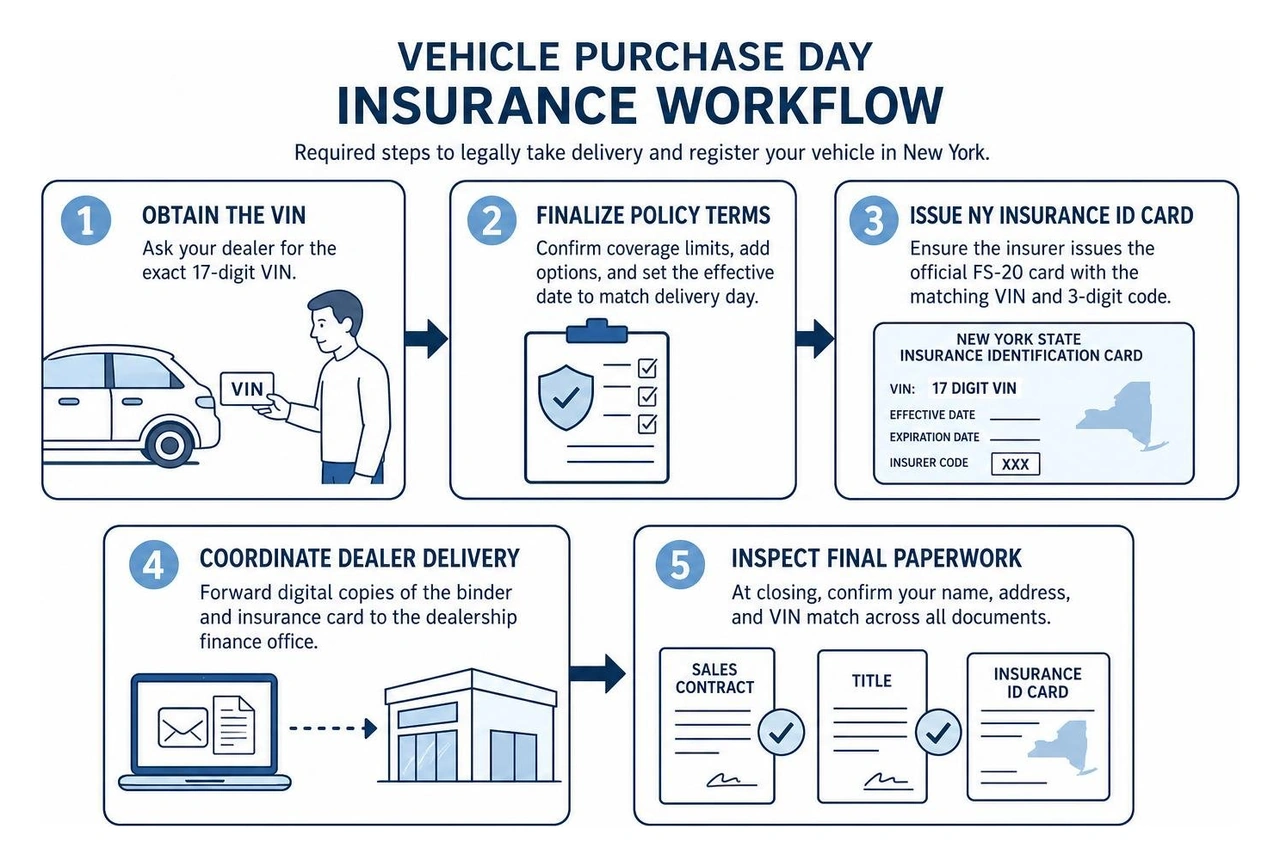
- Obtain the Vehicle Identification Number (VIN): Ask your dealer for the exact 17-digit VIN as soon as you settle on a specific vehicle.
- Finalize the Policy Terms: Contact your insurance agency, confirm your coverage limits, add your physical damage options, and set the policy's effective date to match your delivery day.
- Issue the NY Insurance ID Card: Ensure the insurer or agent issues the official FS-20 cards displaying the matching VIN and the company's 3-digit DMV code.
- Coordinate Dealer Delivery: Forward digital copies of the binder and insurance card to the dealership finance office to avoid delays with registration and plates.
- Inspect Final Paperwork: At closing, confirm that your name, address, and vehicle VIN match identically across your sales contract, title paperwork, and insurance cards.
Titled Owner Mandates vs. Parent Policy Coverage
A common question among first-time car buyers is whether they can insure a newly purchased vehicle on their parents' auto policy. Under New York DMV regulations, the name appearing on the vehicle's title and registration must match the named insured on the auto insurance card.
If you purchase a car and title it solely in your own name, you cannot simply add the vehicle to a parent's policy unless you are a designated named insured on that policy or title the vehicle jointly. When a young driver residing at home purchases a car titled in their own name, they must establish their own individual policy. Multi-car household discounts can still apply if multiple policies are maintained under the same residential address in communities like Patchogue or Holbrook, providing meaningful savings while keeping documentation fully compliant.
Proactive Savings Strategies to Lower NY Car Insurance for First Time Buyers
Car insurance is a significant investment, but you have several practical options to manage your premiums:
- Policy Bundling: Combining your auto policy with a renters or homeowners insurance policy is one of the most effective ways to secure a multi-policy discount on both coverages.
- Higher Physical Damage Deductibles: Choosing a higher deductible (such as moving from $500 to $1,000 for collision and comprehensive) lowers your ongoing premium. Ensure you maintain sufficient emergency savings to cover that out-of-pocket amount if a claim occurs.
- Academic Achievement Credits: Full-time students who maintain a "B" average (3.0 GPA) or higher can qualify for significant premium reductions by maximizing car insurance student discounts in NY.
- Defensive Driving Courses: Completing a New York DMV-approved Point and Insurance Reduction Program (PIRP)—available online or in-person—mandates a mandatory 10% reduction on your auto liability, no-fault, and collision premiums for three full years.
- Telematics and Usage-Based Programs: If you drive fewer miles or practice safe driving habits, consider enrolling in usage-based insurance programs to save money through mobile apps or plug-in devices that monitor speed, braking, and mileage.
High-Risk Alternatives and the Assigned Risk Pool
If a first-time buyer has a challenging driving record, past permit infractions, or credit difficulties that result in declinations from standard voluntary insurance carriers, coverage is still accessible through the New York Automobile Insurance Plan (NYAIP).
Commonly referred to as the "assigned risk pool," the NYAIP was established by state law to ensure that every licensed driver can obtain mandatory auto liability protection. Under this plan, drivers are assigned to licensed New York auto insurers on a rotating basis. While premiums in the assigned risk pool are generally higher than standard voluntary rates, maintaining continuous coverage and a clean driving record for 12 to 24 months allows drivers in Holtsville and Medford to transition back into competitive, voluntary insurance markets.
Frequently Asked Questions About First-Time NY Auto Insurance
Can I test drive a car in New York before setting up my own auto policy?
Yes. Commercial auto dealerships maintain blanket garage liability insurance policies that provide coverage during test drives. You do not need to present an individual auto insurance policy simply to test drive a car on dealership plates. However, the moment you sign purchase documents and take formal delivery of the vehicle, you must have active insurance in your own name before the dealer can release the keys.
What happens if insurance coverage lapses after registering a car in NY?
New York's automated IIES system tracks coverage status in real time. If an insurer notifies the DMV that a policy has been cancelled and no replacement policy is electronically logged, the DMV sends an inquiry letter. If a lapse occurs:
- The DMV suspends the vehicle registration for the exact number of days the vehicle was uninsured.
- If the lapse exceeds 90 days, the driver's license is suspended as well.
- The state assesses mandatory daily civil penalties or requires the immediate surrender of physical license plates to a local DMV office in Patchogue, Holbrook, or surrounding areas. Driving an unregistered, uninsured vehicle can lead to vehicle impoundment and court summonses.
How long before buying a car should a first-time buyer get insurance quotes?
You should begin gathering quotes early in your shopping process—typically 7 to 14 days before purchasing. Obtaining quotes on potential makes and models helps you avoid buying a vehicle that comes with unexpectedly high insurance premiums. Once you settle on a specific vehicle and receive the VIN from the seller or dealer, you can finalize the policy details in under an hour, setting the effective date for your scheduled pickup.
Conclusion
Securing your first vehicle represents personal freedom and independence, but entering the road with proper protection ensures unexpected events won't derail your financial future. Meeting New York's baseline requirements keeps you legal, but tailoring your liability, comprehensive, collision, and personal injury protection creates lasting security for your daily driving.
At Bay Harbour Insurance Agency, we believe every driver deserves clear guidance and personal, client-centered service. As an independent agency rooted right here on Long Island, we work directly for you—comparing options across multiple top-rated carriers to build a policy that fits your budget and lifestyle. Whether you are navigating daily routes in Patchogue, commuting through Holbrook and Holtsville, or operating out of Medford, our team is here to help you hit the road with confidence.
Request your personalized auto insurance policy in New York State today, and let us help you find the right coverage for your first car.